
Posted by Jonathan Wilson Tuesday 13 April 2010 10.31 BST guardian.co.uk
The tweaks of 2005 remain unappreciated but they generated a climate for some of the most beautiful football ever played
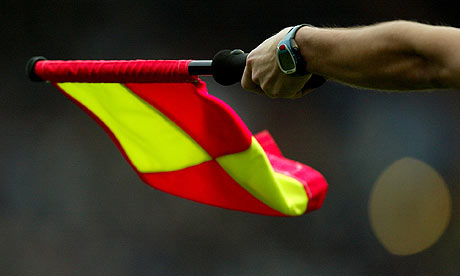
Beauty in action. Photograph: Michael Regan/Action Images
Nothing in football is so traduced as the offside law. Most seem to regard it as a piece of killjoy legislation, designed almost to prevent football producing too many goals and being too much fun, while for the punditocracy it has become the universal scapegoat, the thing that "nobody understands". Just because Garth Crooks doesn't get something, though, doesn't make it a bad thing. The modern offside law may be the best thing that's ever happened to football, and it is almost certainly the reason Barcelona have been so successful with a fleet of players whose obvious asset is their technique rather than their physique.
A brief history of offside
The first laws of the game drawn up by the Football Association in 1863 stipulated that a player was offside if he was in front of the ball: "When a player has kicked the ball, anyone of the same side who is nearer to the opponent's goal-line is out of play, and may not touch the ball himself, nor in any way whatever prevent any other player from doing so, until he is in play…" That effectively militated against passing and the assumptions that underlay that culture continued to shape English football for the following decade. English football in those days was all about head-down charging, which is why England were so startled when they encountered the passing approach of Scotland, who had had no such law, in the first international in 1872.
In 1866, the law was liberalised so that a player was considered to be onside if there were three defensive players between him and the goal (or was behind the ball, which has remained a constant); this was the variant to which Queen's Park committed when they joined the FA four years later. In 1873 that law was modified so that offside was judged when the ball was played, rather than when the player received the ball.
Since then, the process has been of increasing liberalisation. In 1903, the notion of interfering with play was introduced: "It is not a breach of Law for a player simply to be in an off-side position, but only when in that position, he causes the play to be affected." Four years later it was decided a player could only be offside in the opposition's half, and in 1921 that it was impossible to be offside from a throw-in.
Teams, though, had become adept at applying the offside trap. Notts County had begun the trend, but by the mid-20s several clubs, most notably Newcastle United with their full-back pairing of Frank Hudspeth and Bill McCracken, had become so obsessed with offside that games would be compressed into a narrow sliver either side of the halfway line.
When Newcastle drew 0-0 at Bury in February 1925, it came as the final straw. It was Newcastle's sixth goalless draw of a season that produced what at the time was an unthinkably low average of 2.58 goals per game. The football was boring, attendances were falling and the FA, for once, not only recognised that something needed to be done, but set about doing it.
The 1925 change
The FA came up with two possible solutions: either to require only two defending players to be in advance of the forward for him to be onside, or to add a line in each half 40 yards from goal behind which a forward could not be offside. After an exhibition match in which one alternative was trialled in each half, the FA plumped for the former. It was recommended to the International Board, and introduced ahead of the 1925-26 season.
Goals shot up to 3.69 per game in that season, but the ultimate impact was to usher in a radical change in tactics. Previously a side looking to play the offside trap had been able to retain one full-back as cover as his partner stepped up to try to catch the forward; the new legislation meant that a misjudgment risked leaving the forward through one-on-one with the goalkeeper.
What teams did instead was to withdraw the centre-half in the 2-3-5 to man-mark the centre-forward (which is why central defenders in Britain are still referred to as centre-halves). Some, such as the great Austrian journalist Willy Meisl, insisted this was the death of football, and to the extent that it was the end of a particular style of football, he was right. Moving the centre-half led to the 2-3-5 being dismantled as Herbert Chapman developed the W-M formation at Arsenal, from which sprang almost all tactical developments since.
Although the rule change was initially effective, the offside trap had returned by the mid-60s, as the advent of zonal marking and improvements in nutrition and physical training led to the development of pressing. When the likes of Viktor Maslov's Dynamo Kiev or Rinus Michels's Ajax pressed, manipulating the effective playing area to suit their ends, it could produce thrilling football. Once less technically skilled teams did it, particularly when two were ranged against each other, it could lead to the game, once again, being compressed into a narrow band straddling halfway.
Italia 90
It was the sterility of Italia 90, as with so many rule changes, that provided the impetus. First a player level with the second-last defender was deemed to be onside, whereas previously he had had to be behind. Then in 1995 came a subtle change to the wording of the law so that a player was deemed to be active if he was "gaining an advantage by being in that position" rather than, as previously, if he was "seeking to gain an advantage".
But it was in 2005 that the most radical changes came, and the switch to a law that, 142 years after it was first formulated, at last seems to have got it right. First, it was clarified that a player is offside only if a part of his body with which he is legally able to play the ball is beyond the penultimate defender. That, realistically, is academic, for no linesman can make a snap judgment as to whether, say, it is upper arm or torso he can see protruding beyond the defender, but what the change did was to shift the benefit of any doubt yet further in favour of the forward.
More significant, though was the rewording of what it means to be interfering: "Interfering with play means playing or touching the ball passed or touched by a team-mate." A later amendment clarified that: "A player in an offside position may be penalised before playing or touching the ball if, in the opinion of the referee, no other team-mate in an onside position has the opportunity to play the ball.
"If an opponent becomes involved in the play and if, in the opinion of the referee, there is potential for physical contact, the player in the offside position shall be penalised for interfering with an opponent."
The impact of the 2005 change
So to be offside, a player has either to touch the ball or be in a position potentially to make physical contact with an opponent.
Crucially, if a defender steps up because he senses by so doing he would force a forward into an offside position, that is no longer sufficient to render him active. Which means that against savvy opponents, who contrive to keep the ball away from those who have wandered offside, the offside trap has been rendered ineffective.
The figures bear this out. Opta stats show that in 1997-98 there were 7.8 offsides per game in the Premier League, after which there was a fairly steady decline to 6.3 in 2005-06. Since the new legislation came into force, there has been a further decline, to 4.8 so far this season.
There are still pundits – and managers and players and fans – who ask what a defender is supposed to do in situations in which he would previously have stepped out and tried to play offside, or if a player is behind him in the box when a ball is played in. He is, of course, actually supposed to challenge for the ball. Why should defenders be allowed simply to step up? Just because they've done that for 80 years doesn't make it a God-given right.
Although the FA's variant of offside when adopted in 1863 was predicated on a dribbling game, the variants further north – in Nottingham, Derby, Sheffield and Scotland, for instance – where a passing game prevailed, were designed to stop goal-hanging, and prevent the game becoming about endless hoofs into the danger area where a goalkeeper would battle with a handful of forwards who could legitimately stand straight in front of him.
The modern law stops that, but brilliantly it does it without the side-effect of legitimising the offside trap. And that must, even at its most basic level, be a good thing. Surely nobody, not even George Graham, goes to a game thinking: "Hmm, I hope they play some good offsides today?" Making defenders defend, forcing them to mark or block or intercept or tackle, has to be a good thing.
If sides aren't pushing up to play offside, the effective playing area is also larger. A few years ago, there were semi-serious suggestions that the pitch should be made bigger to accommodate players who are physically far larger now than they were in the Victorian era when pitch dimensions were standardised. Smaller players, ran the argument, weren't getting a chance beside physical colossi who were often less skilful, but were better equipped for the attritional conflict football had become.
Stop sides playing the offside trap and they defend deeper, that central band, the effective playing area, expands (hence the widespread shift from three-band formations to four-band formations), and the result is that the size of players matters less and skill is one again prospering. Barcelona's victory in the Champions League and Spain's success in Euro 2008 were both brought about by the sort of small, skilful midfielder who was supposed to have died out two or three decades ago.
The modern offside law remains unappreciated, but it has generated a climate in which some of the most beautiful football ever played has been produced.
The tweaks of 2005 remain unappreciated but they generated a climate for some of the most beautiful football ever played
Beauty in action. Photograph: Michael Regan/Action Images
Nothing in football is so traduced as the offside law. Most seem to regard it as a piece of killjoy legislation, designed almost to prevent football producing too many goals and being too much fun, while for the punditocracy it has become the universal scapegoat, the thing that "nobody understands". Just because Garth Crooks doesn't get something, though, doesn't make it a bad thing. The modern offside law may be the best thing that's ever happened to football, and it is almost certainly the reason Barcelona have been so successful with a fleet of players whose obvious asset is their technique rather than their physique.
A brief history of offside
The first laws of the game drawn up by the Football Association in 1863 stipulated that a player was offside if he was in front of the ball: "When a player has kicked the ball, anyone of the same side who is nearer to the opponent's goal-line is out of play, and may not touch the ball himself, nor in any way whatever prevent any other player from doing so, until he is in play…" That effectively militated against passing and the assumptions that underlay that culture continued to shape English football for the following decade. English football in those days was all about head-down charging, which is why England were so startled when they encountered the passing approach of Scotland, who had had no such law, in the first international in 1872.
In 1866, the law was liberalised so that a player was considered to be onside if there were three defensive players between him and the goal (or was behind the ball, which has remained a constant); this was the variant to which Queen's Park committed when they joined the FA four years later. In 1873 that law was modified so that offside was judged when the ball was played, rather than when the player received the ball.
Since then, the process has been of increasing liberalisation. In 1903, the notion of interfering with play was introduced: "It is not a breach of Law for a player simply to be in an off-side position, but only when in that position, he causes the play to be affected." Four years later it was decided a player could only be offside in the opposition's half, and in 1921 that it was impossible to be offside from a throw-in.
Teams, though, had become adept at applying the offside trap. Notts County had begun the trend, but by the mid-20s several clubs, most notably Newcastle United with their full-back pairing of Frank Hudspeth and Bill McCracken, had become so obsessed with offside that games would be compressed into a narrow sliver either side of the halfway line.
When Newcastle drew 0-0 at Bury in February 1925, it came as the final straw. It was Newcastle's sixth goalless draw of a season that produced what at the time was an unthinkably low average of 2.58 goals per game. The football was boring, attendances were falling and the FA, for once, not only recognised that something needed to be done, but set about doing it.
The 1925 change
The FA came up with two possible solutions: either to require only two defending players to be in advance of the forward for him to be onside, or to add a line in each half 40 yards from goal behind which a forward could not be offside. After an exhibition match in which one alternative was trialled in each half, the FA plumped for the former. It was recommended to the International Board, and introduced ahead of the 1925-26 season.
Goals shot up to 3.69 per game in that season, but the ultimate impact was to usher in a radical change in tactics. Previously a side looking to play the offside trap had been able to retain one full-back as cover as his partner stepped up to try to catch the forward; the new legislation meant that a misjudgment risked leaving the forward through one-on-one with the goalkeeper.
What teams did instead was to withdraw the centre-half in the 2-3-5 to man-mark the centre-forward (which is why central defenders in Britain are still referred to as centre-halves). Some, such as the great Austrian journalist Willy Meisl, insisted this was the death of football, and to the extent that it was the end of a particular style of football, he was right. Moving the centre-half led to the 2-3-5 being dismantled as Herbert Chapman developed the W-M formation at Arsenal, from which sprang almost all tactical developments since.
Although the rule change was initially effective, the offside trap had returned by the mid-60s, as the advent of zonal marking and improvements in nutrition and physical training led to the development of pressing. When the likes of Viktor Maslov's Dynamo Kiev or Rinus Michels's Ajax pressed, manipulating the effective playing area to suit their ends, it could produce thrilling football. Once less technically skilled teams did it, particularly when two were ranged against each other, it could lead to the game, once again, being compressed into a narrow band straddling halfway.
Italia 90
It was the sterility of Italia 90, as with so many rule changes, that provided the impetus. First a player level with the second-last defender was deemed to be onside, whereas previously he had had to be behind. Then in 1995 came a subtle change to the wording of the law so that a player was deemed to be active if he was "gaining an advantage by being in that position" rather than, as previously, if he was "seeking to gain an advantage".
But it was in 2005 that the most radical changes came, and the switch to a law that, 142 years after it was first formulated, at last seems to have got it right. First, it was clarified that a player is offside only if a part of his body with which he is legally able to play the ball is beyond the penultimate defender. That, realistically, is academic, for no linesman can make a snap judgment as to whether, say, it is upper arm or torso he can see protruding beyond the defender, but what the change did was to shift the benefit of any doubt yet further in favour of the forward.
More significant, though was the rewording of what it means to be interfering: "Interfering with play means playing or touching the ball passed or touched by a team-mate." A later amendment clarified that: "A player in an offside position may be penalised before playing or touching the ball if, in the opinion of the referee, no other team-mate in an onside position has the opportunity to play the ball.
"If an opponent becomes involved in the play and if, in the opinion of the referee, there is potential for physical contact, the player in the offside position shall be penalised for interfering with an opponent."
The impact of the 2005 change
So to be offside, a player has either to touch the ball or be in a position potentially to make physical contact with an opponent.
Crucially, if a defender steps up because he senses by so doing he would force a forward into an offside position, that is no longer sufficient to render him active. Which means that against savvy opponents, who contrive to keep the ball away from those who have wandered offside, the offside trap has been rendered ineffective.
The figures bear this out. Opta stats show that in 1997-98 there were 7.8 offsides per game in the Premier League, after which there was a fairly steady decline to 6.3 in 2005-06. Since the new legislation came into force, there has been a further decline, to 4.8 so far this season.
There are still pundits – and managers and players and fans – who ask what a defender is supposed to do in situations in which he would previously have stepped out and tried to play offside, or if a player is behind him in the box when a ball is played in. He is, of course, actually supposed to challenge for the ball. Why should defenders be allowed simply to step up? Just because they've done that for 80 years doesn't make it a God-given right.
Although the FA's variant of offside when adopted in 1863 was predicated on a dribbling game, the variants further north – in Nottingham, Derby, Sheffield and Scotland, for instance – where a passing game prevailed, were designed to stop goal-hanging, and prevent the game becoming about endless hoofs into the danger area where a goalkeeper would battle with a handful of forwards who could legitimately stand straight in front of him.
The modern law stops that, but brilliantly it does it without the side-effect of legitimising the offside trap. And that must, even at its most basic level, be a good thing. Surely nobody, not even George Graham, goes to a game thinking: "Hmm, I hope they play some good offsides today?" Making defenders defend, forcing them to mark or block or intercept or tackle, has to be a good thing.
If sides aren't pushing up to play offside, the effective playing area is also larger. A few years ago, there were semi-serious suggestions that the pitch should be made bigger to accommodate players who are physically far larger now than they were in the Victorian era when pitch dimensions were standardised. Smaller players, ran the argument, weren't getting a chance beside physical colossi who were often less skilful, but were better equipped for the attritional conflict football had become.
Stop sides playing the offside trap and they defend deeper, that central band, the effective playing area, expands (hence the widespread shift from three-band formations to four-band formations), and the result is that the size of players matters less and skill is one again prospering. Barcelona's victory in the Champions League and Spain's success in Euro 2008 were both brought about by the sort of small, skilful midfielder who was supposed to have died out two or three decades ago.
The modern offside law remains unappreciated, but it has generated a climate in which some of the most beautiful football ever played has been produced.


 ) but that's precisely the problem. They've made a law which is unworkable as things stand.


Comment