Announcement

Collapse
No announcement yet.

Our Financial Situation

Collapse
X
 
  • Filter
  • Time
  • Show
Clear All
new posts

    Our Financial Situation

    Right'o I know IRWT made a similar thread about Liverpool financial talk, but as his thread was a complete car crash I wanted to make a thread that was a little more serious as I have a few questions about the financial side of our club .

    Firstly, What is an overview of the financial fair play rules, and how will this affect us? will the big money signings of say Henderson for a reported 20 million and possibly Downing for a similar price affect our position due to the rules will we not be able to sign any more players for example, Also can out high wages for players such as N'gog, Cole etc put us in a weaker position in the transfer market?

    Also, reading something that was supposed to be our accounts from 2009 (when we where obviously under Hicks and Gillette) we made a loss of £54.9m, is there any chance of this happening under FSG?

    Finally, to put it bluntly how rich are FSG, is there any chance at all of us 'Doing a Leeds'

    I know these questions might sound a bit daft to people more ITK but no doubt there is more people that are a bit curious like me, who don't know all the facts

    EDIT: Try not to turn this argument into a big debate about who is right and wrong, try and keep it to the facts.
    Last edited by Gibbo; 07-07-11, 12:40 AM.
    The times they are a changin'.

    #2
    This is a very good article on FFPR and possible impact on Liverpool


    The aim of this article is to set out briefly the rationale for the new UEFA rules, then go into a little bit of detail about what they say, and then offer some insight into their significance for Liverpool Football Club. The article will try and demonstrate that, in the short term at least, due to the unfortunate timing of the proposed takeover and the lack of any significant funds in the last few transfer windows, Liverpool Football Club has not been able to take advantage of the UEFA rules used to calculate whether a club has broken even. There is no coincidence that Manchester City are spending fortunes this summer, because from the 2011/12 season, as will be described below, the club runs the risk of breaching the UEFA rules by spending over and above what they earn.


    Background

    UEFA and its president, Michel Platini, have long been concerned that clubs who continually make losses and, as a result, accumulate debt are not playing by the rules of fair competition. The Premier League, and in particular its chief executive, Richard Scudamore, has been wary of lessening the global attractiveness of the Premier League by curbing the ability of owners to subsidise their clubs or, in some cases, milk their clubs dry. Tellingly, however, UEFA has implemented, as part of its already functioning club licensing system, the Financial Fair Play Rules (FFPR) to ensure a club, more or less, has to balance its books.

    UEFA’s overall aim for the FFPR is for its affiliated football clubs to balance their books, not spend more than they earn, and to promote investment in their stadia and training facility infrastructure and youth development. This idea of self-sustainability relates to UEFA’s underlying belief that transfer fee and wage inflation continues unabated because each set of new club owners injects more money into the European football club market. This ‘keeping up with the Joneses’ effect spirals further because a new owner then has to outbid other high-spending clubs.

    Whilst the beneficiaries are no doubt the players who are earning ever more lucrative salaries, the clubs (through their representative ECA body) have been seeking ways with UEFA to actually limit their own spending. This may seem rather ironic in the case of Chelsea, given their £120m loss in 2004, but it actually makes perfect sense; Mr Abramovich, after spending over £700m, sees the fallacy of football clubs constantly outdoing one another. The very clubs that are being restricted by these rules are the ones that have actively participated in, and consented to, the proposals. Clubs are asking UEFA to save them from themselves. UEFA, along with the various interest groups, put forward proposals in order to create a deflationary effect across UEFA affiliated national football associations.

    The Basics

    It should be borne in mind that the new FFPR relate only to Champions League and Europa League, and not to domestic league, participation. Each club that believes it can qualify for that season’s European competitions must, prior to the beginning of that season, apply for a UEFA Club Licence. From the 2013-14 season, the licence stipulations will include adherence to the FFPR. Until the 2013-14 season, there are no sanctions for breaching the FFPR.

    The FFPR will therefore start to bite from the 2013-14 season. The rules need to be borne in mind from the 2011-12 season onwards because the 2011-12 and 2012-13 season accounts are used to determine a club’s licence application in the 2013-14 season. For Liverpool, it means the club is unlikely to take advantage of the loophole that clubs like Manchester City are using for their benefit (i.e. buying this season so transfer spending does not appear in their 2011-12 accounts). Manchester City may still have break-even problems if their wage bill is as astronomical as most newspapers speculate.

    The rules also encourage investment in youth development and infrastructure. Such infrastructure includes stadium and training ground development and expenditure in a club’s academy. Any club has the incentive to spend in these areas, should they wish to participate in European competition, because the FFPR does not count such investment as expenditure for the purposes of its break-even calculation. Therefore, any new funding for the proposed Stanley Park stadium will not impact on Liverpool’s ability to pass the FFPR because such finance would be excluded.

    As any potential stadium is not included in UEFA’s break-even calculation, Liverpool’s next owners will be free to plant the first shovel in the ground, safe in the knowledge that higher levels of income will be generated which should aid Liverpool with their break-even requirement. The greater the commercial revenue growth funded by long-term infrastructure investment, the larger the revenue to balance against expenditure.

    UEFA has also been at great pains to stress that they are not anti-debt. With Manchester United’s huge reported debt and our own debt inching towards it, Platini placated various debt-ridden clubs with the distinction that so long as the debt is being serviced (i.e. profit is covering interest payments) UEFA does not have a problem. Issues become more delicate when interest payments to service the debt do not cover the profit made. Sound familiar/worrying? From Liverpool’s latest published accounts, its trading profit of £27.4m fell someway short of the £40.1m required to service the interest payments due. The latest accounts certainly show Liverpool Football Club in the wrong type of red.

    Acceptable Deviation = Break Even (ish)

    A few important points to bear in mind. Usually, break-even means expenditure must equal revenue. Not in this case; at least at the outset of these rules. This is because included in the break-even calculation are the acceptable deviation provisions (code for a little bit of a loss is acceptable in the first few years). Clubs will not have to break even until 2018/19 season at the earliest.

    The revenue that is taken into account for break-even purposes includes gate receipts, broadcasting rights, commercial sponsorship details and profit on player transfers. Expenditure includes player transfers, wages and associated costs and other operating expenses. There are also anti-evasion mechanisms like arms’-length trading and related-party transaction requirements.

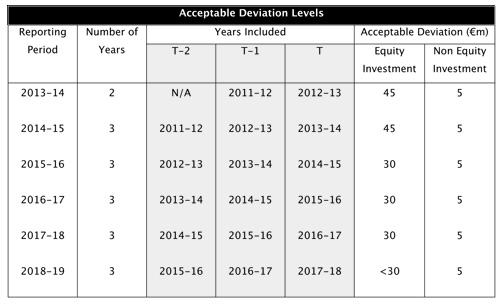
    The acceptable deviation provisions allow a club with some losses over a certain number of seasons to ‘break even’ and therefore pass the FFPR. Without trying to get too technical, below is a table that I have amended slightly from an excellent Swiss Ramble blog on the FFPR.


    In taking the first row as an example, the rules come into force in the 2013-14 season. The reason why this is important is because, in the first year, two years’ worth of accounts are used to assess whether a particular club can successfully apply for its UEFA Club Licence.

    Therefore, a club’s accounts for years 2011-12 and 2012-13 are used to determine the licence application. This is crucial because the present 2010-11 season accounts are not taken into account. The reason why Manchester City are investing so heavily now in their playing squad is because the overinflated transfers will show up as major expenditure only in their year-ending 2010-2011 accounts. Should they spend this type of money in the next summer’s transfer window (for the 2011-12 season (T-1)), such spending would be taken into account for the break-even calculation, which could have a damaging effect on being granted a UEFA licence.

    Indeed, the FFPR may signal the end of the mega transfer because a club may simply not be able to afford a £50m fee and then break even. This is of course unless a club makes big commercial profits, which very few clubs (bar Arsenal) have done recently.

    Strategically, if Chelsea or Manchester City want to buy Torres at a figure around £50m-60m, they would probably have to do it during this, or the January, transfer window. This would keep the Torres transfer off their 2011-12 season balance sheet. Otherwise, from the 2011-12 season onwards a club would have to make windfall revenues from their commercial activities (or sell another top player) to afford a marquee signing like Torres to balance the books. (Note: it may be possible to take a loan to fund a large transfer so long as the interest repayments do not send a club into the red.)

    The table shows that the acceptable deviations (i.e. losses) vary quite considerably. From the 2013/14 season when the rules practically come into force, an owner can invest up to €45m over two seasons in exchange for more shares in the club. It means that after the 2013-14 season an owner can on average exchange only €15m worth of cash for shares each year to spend on transfers and wages, etc. That figure is reduced to €10m per season (€30m over three seasons) for the 2015-16 season. If an owner does not put any money into a club by way of cash for shares, each club’s acceptable loss (by reference to the last column in the table) is a mere €5m over three years.

    Sanctions

    The Club Financial Control Panel will conduct club audits to ensure that the system is applied correctly. If the Panel believes that the FFPR have not been fulfilled, it can refer the case to the strangely named Organs for Administration of Justice, with the ultimate sanction being a ban from UEFA competitions [and harvesting of your kidneys? PT].

    The UEFA Disciplinary Regulations do provide for a whole host of possible sanctions including a reprimand, a fine, disqualification from competitions in progress and/or exclusion from future competitions or withdrawal of a licence.

    Although the above are all possible sanctions, it appears likely from the outset (from the 2013-14 season) that a soft-touch approach may well be applied, simply because these rules were in part drafted by the clubs not wanting harsh sanctions for breach of the rules. This is unless presumably there is a blatant flouting of the rules (i.e. someone posting a loss similar to Chelsea’s £140m loss in the 2004/5 season).

    Why a soft-touch approach? Because there is nothing set in stone in the rules which says a club falling outside of the break-even parameters will automatically have its licence refused. Indeed there is even a provision where clubs can be in breach of the break-even calculation and still not be sanctioned at all! (Annex 11(2) for those wanting to know where to look).

    It should be borne in mind that Real Mallorca have, at the time of writing, been refused entry into this season’s Europa League because they failed to meet the UEFA Club Licensing entry criteria. This decision can however be appealed to the Court of Arbitration for Sport.

    Such an instance does illustrate the powers UEFA has to refuse a club licence application. When the FFPR get added to the licence criteria in time for the 2013-14 season, the rules will be stricter than those applied to Real Mallorca. A future high-profile UEFA refusal of a club licence application should not however be ruled out.

    What does this all mean for Liverpool?

    Short-Term Significance

    Before the impending ownership changes were mooted, this piece was very much a ‘missed opportunity’ article. This was because I thought it highly unlikely that the current owners would either authorise a spending spree or sell before the transfer deadline with enough time for someone else to invest heavily. I presume that this will unfortunately still be the case.

    As already mentioned, transfer spending completed before the 2011-12 season (as the first accounting period UEFA uses to measure the break-even test) would not be included in the UEFA FFPR calculations. Any large transfer spending, if it is not done in this summer or winter transfer window, would be taken into account by UEFA.

    That is why it is so imperative for Liverpool, if they are going to get any transfer money from the new owners, to spend it quickly (and wisely!).

    Longer-Term Significance

    I may be proved wrong but this is where I believe the rules are in Liverpool’s favour. Unlike smaller Premier League clubs who will probably have only a finite level of commercial income (mid-range stadium capacity, merchandising sold only in the local area, limited commercialisation of overseas markets), Liverpool are one of only a small number of global football institutions that have the ability to expand their international commercial activities.

    Additionally, and most importantly, the club has the potential for a much larger stadium to bring vastly increased revenues. Liverpool’s annual match-day income from their latest accounts of £42.5m is dwarfed by Arsenal’s £100.1m and Manchester United’s £108.8m in revenues. Being debt-free (a big ‘if’) and having £60m worth of additional revenue each season creates a much larger revenue stream with which to break even.

    Therefore, in the long term, Liverpool’s hopefully increasing international commercial performance (perhaps into China) along with the potential revenue windfall of a new stadium should allow the Reds to keep within the rules by having larger revenues to balance against larger transfer spending.

    Liverpool’s global following should give the club a disproportionate revenue advantage when compared with probably all but two or three other Premier League clubs. The fact that Liverpool are 7th (measured by revenue) in the Deloitte Football Money League 2010 for Europe shows the potential for further revenue growth.
    Member #1 of the Luis Suarez fan club

    Comment


      #3
      If you want to know how LFC stacks agains majority of the world best in terms of variour revenue sources and what would be the areas that we need to compete with Real, Barca, ManU, Deloitte Football Money League 2011 is a very good read.

      Member #1 of the Luis Suarez fan club

      Comment


        #4
        Originally posted by Mostar View Post
        This is a very good article on FFPR and possible impact on Liverpool

        http://tomkinstimes.com/2010/08/the-...-liverpool-fc/
        Tweet Version?

        Comment


          #5
          Originally posted by Baracus View Post
          Tweet Version?
          Luckily not his article
          Member #1 of the Luis Suarez fan club

          Comment


            #6
            Thats good.

            So we still have to finance a striker, a centre back, a left back, and left winger.

            And no one wants to buy any of our crap players.

            What was our profit before transfers and interest? I guess if we can average it out over two years. its better to spend it now, and tighten the purse strings next season. If we can get into the top four, thats a big boost as we cant be excluded until the following year anyway.
            In the beginning, Fowler created the Heaven and the Earth.

            Comment


              #7
              apparently man city have agreed a £150m deal for the naming rights to eastlands. unsurprisingly the sponsor happens to be etihad which is a state owned asset.

              uefa are looking closely into the matter and if they had any bollocks they would rule a conflict of interest and disallow the etihad sponsorship to go ahead.

              but knowing blatter and the bent cronies who work at uefa it'll be hushly swept under the carpet and city will have cleverly circumnavigated the financial fair play rules.
              Last edited by el matador; 08-07-11, 12:16 AM.
              [B]Sir Isaac Newton knew the universal law of karma - any action has its equal and opposite reaction.[B]

              Comment


                #8
                Originally posted by el matador View Post
                apparently man city have agreed a £150m deal for the naming rights to eastlands. unsurprisingly the sponsor happens to be etihad which is a state owned asset.

                uefa are looking closely into the matter and if they had any bollocks they would rule a conflict of interest and disallow the etihad sponsorship to go ahead.

                but knowing blatter and the bent cronies who work at uefa it'll be hushly swept under the carpet and city will have cleverly circumnavigated the financial fair play rules.
                Blatter is FIFA
                James Philip Milner Fanclub #1

                Curtis Julian Jones Fanclub #1

                Comment


                  #9
                  Originally posted by el matador View Post
                  apparently man city have agreed a £150m deal for the naming rights to eastlands. unsurprisingly the sponsor happens to be etihad which is a state owned asset.

                  uefa are looking closely into the matter and if they had any bollocks they would rule a conflict of interest and disallow the etihad sponsorship to go ahead.

                  but knowing blatter and the bent cronies who work at uefa it'll be hushly swept under the carpet and city will have cleverly circumnavigated the financial fair play rules.
                  Originally posted by Rich View Post
                  Blatter is FIFA

                  It's Platini and i can see him making an example of a British/English team (probably us )
                  We come not to play.

                  Comment


                    #10
                    thats even better then because platini hates the english league and being french he has a thing against arabs. hopefully they wont allow this to happen and city will have to sell a load of players and go back to being crap again.
                    [B]Sir Isaac Newton knew the universal law of karma - any action has its equal and opposite reaction.[B]

                    Comment


                      #11
                      Originally posted by el matador View Post
                      thats even better then because platini hates the english league and being french he has a thing against arabs. hopefully they wont allow this to happen and city will have to sell a load of players and go back to being crap again.
                      What a massive over-generalisation.
                      .
                      Suppose you have a physicist and a sociologist standing at the side of a field, observing a set of events unfolding on the field. The physicist does [describes] it using the terminology of mass and velocity and frequency of radiation and the rest. And the sociologist does it by describing it as a rugby match.


                      May the Lord bless this post.

                      Comment


                        #12
                        Originally posted by el matador View Post
                        apparently man city have agreed a £150m deal for the naming rights to eastlands. unsurprisingly the sponsor happens to be etihad which is a state owned asset.

                        uefa are looking closely into the matter and if they had any bollocks they would rule a conflict of interest and disallow the etihad sponsorship to go ahead.

                        but knowing blatter and the bent cronies who work at uefa it'll be hushly swept under the carpet and city will have cleverly circumnavigated the financial fair play rules.
                        Figures reported anywhere from £120-150 million for 10 years

                        I actually dont think that is a conflict of interest (you are allowed such sponsorships under the UEFA FFPR) and I actually dont think the figure is a grossly inflated one

                        It might be slightly top heavy but not by much imo
                        Bob Paisley - "This club has been my life. I'd go out and sweep the street and be proud to do it for Liverpool if they asked me to."

                        Comment


                          #13
                          The interesting thing with this though is that it's sponsorship for an already existing stadium (albeit just a few years old). Alot of people were saying that you could only really attract sponsorship for a new stadium.
                          The only gracious way to accept an insult is to ignore it; if you can't ignore it, top it; if you can't top it, laugh at it; if you can't laugh at it, it's probably deserved.

                          Comment


                            #14
                            Actually I think that it might be too much considering it is not a new stadium (which is worth more for naming rights).

                            Interesting test case me thinks

                            Comment


                              #15
                              Originally posted by el matador View Post
                              apparently man city have agreed a £150m deal for the naming rights to eastlands. unsurprisingly the sponsor happens to be etihad which is a state owned asset.

                              uefa are looking closely into the matter and if they had any bollocks they would rule a conflict of interest and disallow the etihad sponsorship to go ahead. but knowing blatter and the bent cronies who work at uefa it'll be hushly swept under the carpet and city will have cleverly circumnavigated the financial fair play rules.
                              I think your missing the point here.

                              1) UEFA have no authority to prevent any financial deal anywhere outside of UEFA itself.

                              2) The purpose of FFP rules is to prevent sugar daddy type support or unsustainable expenditure. The fact is Man City are now a biggish team and there will be multiple companies interested in a naming rights deal for the stadium. Selling it to Mansour himself isn't against the rules, what is against the rules is paying above a fair market price. 10-15mil per year is about the going price.
                              "that is my opinion and that is more important than what anyone else has to say about it" - Mr A.Fergusson, Oct 2011

                              Comment

                              Working...
                              X