
As long as she offers a choice that'll be fine. I don't want any of this "you'll eat what you're given" nonsense. It's the 21st century and we have to work together.
-
.
Suppose you have a physicist and a sociologist standing at the side of a field, observing a set of events unfolding on the field. The physicist does [describes] it using the terminology of mass and velocity and frequency of radiation and the rest. And the sociologist does it by describing it as a rugby match.
May the Lord bless this post. -
that sounds suspiciously like we are all in this togetherComment
-
The difference is I mean it's about compromise and respect whereas for the Tories it means we ordinary people are only in it up to our necks while the rich few are in it all the way up to their toes, the poor lambs..
Suppose you have a physicist and a sociologist standing at the side of a field, observing a set of events unfolding on the field. The physicist does [describes] it using the terminology of mass and velocity and frequency of radiation and the rest. And the sociologist does it by describing it as a rugby match.
May the Lord bless this post.Comment
-
Whatever that means!?!? What's Kenny in charge of if Comolli is in charge of "footballing" things??Originally posted by cream View Post
DC is a scout. If he has any power to over rule Kenny whatsoever then we're in a joint managerial scenario again, only under a different guise.Comment
-
Director of Football is somewhat more than a scout. If things go tits up this season you can bet your last penny that Dalglish will get the bullet before ComolliOriginally posted by WarrenB View PostComment
-
He is doing what he did at Tottenham that is scouting for young english players. Might not be a bad thing for the English game but are we overpaying for them?Comment
-
kenny doesn't have to lend his clothes to new signings.dave of mutilation
Comment
-
Comolli: Our transfer strategy
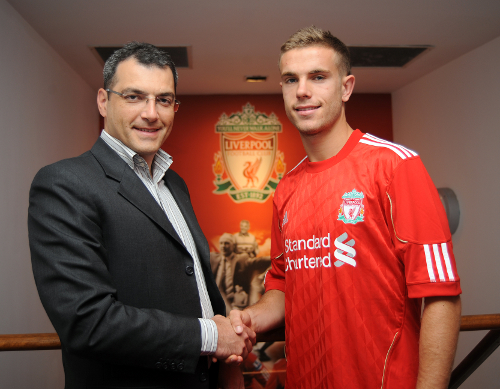
In a fascinating interview following the signing of Jordan Henderson, Director of Football Damien Comolli spoke to Liverpoolfc.tv about how good the 20-year-old can become, our transfer strategy this summer and the future of David Ngog.
The Frenchman also revealed what was said between Henderson and Kenny Dalglish with regards first-team opportunities, and explains why he personally spoke to Steven Gerrard ahead of any potential move for the midfielder.
There has been a lot of talk about this transfer over the last few days and about potential fees. How pleased are you that it's finally done?
I'm very pleased because he was one of the targets we had and when you get your first target it's always a good sign because you think the others will come through as well. We are very, very pleased. He has got all the skills technically that we needed. He's good with the ball, he's creative, he's got good passing, he's physically very good. That's everything we wanted in a midfielder and he's versatile as well. For Kenny he will be the player we wanted. On the fee, I've read and heard a lot of things. There was a lot of speculation on how much we would pay for Jordan and none of the figures I've seen are correct so far. We've paid a price that we are comfortable with, otherwise we would not have done the deal.
Having spoken at length with Jordan, are you confident he's got the mentality to be a big player for Liverpool?
Definitely. It is very difficult to believe you are talking to a 20-year-old. You think you're talking to a 25-year-old. He's very passionate about football, very committed, a top professional. He's the type of player who'll stay behind after training and do extra work. When you talk to him it's not about money or anything related to off the pitch. Everything is on the pitch: where am I going to play, have I got a chance to play, where can I develop most as a player. Kenny and I were very impressed with that and his commitment and passion for the game.
He's only 20-years-old and people talk about his potential but do you see him as a player for now, someone who can slot straight into the team?
Oh yes, he is definitely a player for now. Obviously it's up to Kenny to decide but we see him as a player for now. In all the talks Kenny had with him he said, 'If you come you will be very, very, very much a part of my plans.' We know we are building for the future, a bit like with Luis and Andy in January, but we are also signing a player who is going to be effective from day one.
He's only going to blossom playing next to players like Steven Gerrard, isn't he?
Absolutely. I think that was a key factor for him. I spoke to Stevie about Jordan before we signed him. Stevie was very positive because obviously they have been together in the England camp. I know Jordan really appreciated the fact he was able to play next to Stevie with England. He will learn from players like Jamie Carragher or Stevie or Dirk Kuyt. I think he looked into the history of the club as well.
How good can he become?
That's so difficult to say. I don't know. He's only 20-years-old but he's already played for England, a full international, and that's a massive achievement. What he will be, we don't know - but we know he's already a very good player. We think he's going to be a top player and that's all that matters. We don't want any negative pressure around him. We just want him to come and give us the qualities and skills that he's got, and to enjoy his football.
There is talk of us targeting the best young English talent this summer - is that the strategy?
Yes and no. It's not because a player is English and young that we are going to go for him. We go for a player because he ticks all the boxes. It's what we need at this time in this window. If a player is English or British or has played in the Premier League we'll look at that over someone who is abroad but it could be any nationality as long as they tick the boxes and is what we need for this window and going forward.
We've completed a major transfer early in the summer. We haven't seen that a lot at Liverpool over recent years - again, is that a strategy?
That's the way I personally like to work. The earlier the better because we can then readjust our strategy or decide we aren't going to do any more - which won't be the case now! I didn't know it wasn't the case before but it's certainly something we are trying to do.
Just finally, how will this deal impact upon the future of David Ngog?
Sunderland have had a strong interest in David, so we've agreed to let David speak to Sunderland about his future to see if he's interested in going there. They've expressed a strong interest, so we'll see what's next for him.Member #1 of the Luis Suarez fan clubComment
-
Interesting article on Comolli.

DAMIEN COMOLLI: AN EYE FOR TALENT WITH A TALENT FOR DETAIL
Eyebrows were raised, especially those with a Spurs connection, when Damien Comolli returned to the English Premier League with Liverpool Football Club. Damien was appointed as the Director of Football Strategy by Liverpool FC and Fenway Sports Group (FSG) in November last year. He then was promoted as Director of Football. His previous excursions in to the Premier League have received mixed reviews. A short time spent Googling ‘Damien Comolli’ offers an array of perspectives from various (expert) commentators. This interview offers us a chance to hear for ourselves Damien’s thoughts on talent identification, scouting, recruitment and player development.
Comolli was a young player with AS Monaco until his late teens. At this early age he appeared to have an eye for talent. His own eye critiqued his own ability and concluded that he was not good enough. The continuation of ‘some’ type of career in football required an alternative strategy. The customary coaching licenses followed alongside a further ‘what if’ contingency of a degree in Law. The law degree doesn’t feature significantly in our early exchanges, and acts only as a vehicle for learning and structuring work. I’m sure that a law degree offers more than this, but Comolli is content to focus on the football education that he required in order to secure a future in the game. A coaching position at AS Monaco was subsequently secured. Arsene Wenger was the manager at the time and a significant ally in Damien’s future career choice and undoubtedly his practice. In 1996 an under 18s coaching position at Nagasaki in Japan proved an attractive proposition. Subsequently, his encounters with Wenger continued and the relationship evolved. Two years later, and one year in to Wenger’s tenure at Arsenal, he offered Comolli a position as the Gunners’ European Scout. Comolli’s experiences thus far included playing and coaching, even a spot of goalkeeper coaching. He also admits to being swayed towards fitness and conditioning. Those with any sense of football nous believe, rightly or wrongly, that they can ‘spot’ a player. However, to take on such a high profile and critical role with little or no experience of ‘scouting’, in a new country and at such a high profile club would appear a fairly daunting prospect. Comolli spent a year ‘learning’ this new trade, ‘understanding what scouting was about’. Any thoughts of returning to the coaching environment petered out after a couple of years, as his confidence and reputation for spotting and recruiting talent evolved.
Comolli’s CV possesses two stints at Saint Etienne as Sporting Director and a 3 year period as Tottenham’s Director of Football. All of these appointments embraced a wider brief than his role at Arsenal, including more strategic development plans, medical provision, scouting and contract negotiations. These roles also saw Damien positioned as an intermediate between those that run the club, the owners and the head coach. With no real management experience, other than watching others, his first stint at Saint Etienne was a steep, but valuable, learning curve; one that Damien claims enabled him to learn a vast amount in a very short period of time. Comolli has learnt quickly. He is also quick to recognise the importance of having good people around him, good people who know the demands and identity of their club.
Comolli has been involved in either coaching, identifying, scouting and/or recruiting players to the highest level for nearly 20 years. He is well aware of the complex intricacies of talent identification and development. In essence, the facets of talent ID and development include a complex mosaic of talent considerations including, technical, tactical, physical, physiological, psychological, social and cultural issues. So, in scouting a player, what should you be looking for? Comolli recounts the evolutionary nature of his existence and subsequent evolution of the talent scouting and recruitment process, ‘I would say there has been a major change in the last 3 to 4 years whereby I think now we need to look a lot more at the psychological aspect of the player, the attitude of the player, the mentality of the player on the pitch than we used to… before, it was all about the talent and the physical ability and I think now probably with the style of play of the likes of Barcelona and Arsenal… I think we are now more orientated towards the attitude of the player. Is he a team player? Is he intelligent enough that he puts himself at the disposal of the team? The first thing we used to look for is the talent, but not anymore. What we want, is a talented player but with the right attitude and intelligence.’ Comolli explains further and continues to champion the notions of attitude, respect for the team and intelligence, ‘You can sense from what he (the player) does on the pitch, his intelligence and practical awareness can usually be seen without having to meet the player, you want players to be able to use that talent for the team and to be a team player… Obviously, when you work in the Premier League you need to look out for physical attributes because it’s physically very demanding, you need to be strong, you need to be quick. But coming back to the talent, how do you use it? How does the player use the talent they’ve got?’ Comolli works hard to translate this philosophy to his scouts and recruitment staff. Additionally, he recognises that each club is different, each manager is different, ‘You have to respect what the club wants, how the club wants to play and the type of player the club wants to bring in… it’s not worth putting a player that you like as a scout but doesn’t match with what the club needs or what the club is looking for, or doesn’t match the playing philosophy or identity (of the club).’ These words are rarely heard in the talent recruitment corridors of many top-level (and lower-level) football clubs, or rarely are they fully articulated in this way. The job is to educate the scouts, create regular and direct communication between them and the coaching staff. The best scouts ‘get it, usually, but if they don’t, it’s about bringing them here and making them understand what we look for, trying to make them understand what the club’s philosophy is in terms of our approach to playing the game and our (the club’s) identity.’ The ideal scout is one, ‘that has got a great eye, a great judgement of player and also a fantastic network.’ The eye in this regard, must match the needs of the club (i.e., both the academy and the first team), the club’s playing philosophy and the identity of the club. I sense that first of all, you need to spend some reconnaissance time to understand what these immediate needs are and then translate this to the coaches and scouts who must begin to recognise and understand that the needs of the club and the subsequent identity of the club is about ‘today’ as opposed to ‘yesterday’ or some bygone era.
The process of recruitment is, more than ever, a strategic operation. At a first team level, due diligence must be afforded to potential multi-million pound acquisitions. The initial player recommendations of the scout are followed up by at least 3 to 4 more viewings from ‘other’ senior staff. Subsequently, three positive reports will trigger a ‘buying’ mechanism, ‘the beauty of having different people is that different people watch different things. They have a slightly different eye, depending on their experience, their personality or background as maybe a coach or maybe a player… the diversity is key… you want to develop a situation where people can challenge, challenge me or the manager. You know, saying that’s my opinion, you may not agree with me but I’ll give you my opinion because that’s the way I think and that’s what I’ve seen… you want your scouts to be strong, not sit on the fence, make a recommendation, yes, no, why. You want a strong recommendation either way.’ Comolli recognises that today’s outlay on players requires more than just a playing recommendation. The recommendation must go beyond the pitch. Compiled reports require information about the player’s lifestyle, his approach to training, what he eats and drinks, his family and his background. The narrative conjures up images of scouts being schooled watching re-runs of the exploits Jim Rockford or Eddie Shoestring. Yet understanding every aspect of a player is critical in guiding the ultimate call as to whether you spend a few million. There are no guarantees. We are all fully aware of those players that have not travelled well or settled well into their new club. High outlay and high expectations with little or no delivery or reward (no matter what the circumstances) is an equation that Comolli wishes to avoid. Reducing the risk is paramount. Comolli explains that his role is to try to anticipate whether a player will adapt to life in his new club, with his new team mates, his new city (new country even) or new environment before the club signs them. The club then works with the player’s agent to help the player and his family to settle and become more independent. This post-signature aspect of player recruitment has been traditionally neglected by numerous factions within football. Comolli maintains that this is a critical part of his and the club’s role.
Comolli’s role is not confined to first team player recruitment. He’s also involved in the development of the scouting network for the Academy. He recognises that scouting the younger ages is even more challenging, ‘the younger you look at them the more difficult the scouting job is… it is so difficult to try to get a player who is (say) 12, and predict that he’s going to be a top player at 18. The older they are the easier it is from a scouting point of view. But in terms of what we are looking for in a player it is exactly the same thing; talent, attitude, intelligence, tactical awareness. We are taking more of a gamble because we don’t know how a player is going to change between 12 to 15 or 16 and 19 and also 17 and 19 or 17 and 20… you don’t want to sign a player who is 15 and fully matured because you know there is no room for development, from a physical point of view and sometimes from a psychological point of view as well, because sometimes the player will dominate his category at 15 but not so much at 20. So that’s the basic thing to take into consideration. But again, we tell the scouts to not just look only at the talent, but look at what the player is like with his talent and how he uses his talent, so it’s coming back, a little bit, to how we work with the first team.’ The judgement of talent in these early years appears more flexible. There also appears to be a sense of cultural congruence between the first team and the academy. Comolli reiterates his philosophy; talented players, with intelligence, a respect for the team, a sense of selflessness and an ability to develop and learn. At this point he recounts the words of Ernie Accorsi, the former General Manager of the NFL’s New York Giants football team, ‘He used to say that if a kid has had a good attitude in the past but lost his way, you can make him good again but if your kid has never had a good attitude then you’ll never make him good.’ The sentiment here refers back to attitude. Comolli describes his evolving experiences, ‘you think yeah his attitude is no good but we’re going to change him… you’ve got no chance…you always want to meet the player and sometimes you’ve got to make a judgement without really knowing the person personally. But if you think his behaviour is not right but you know he’s going to come into our environment are we going to make him better are we’re going to change him totally, it doesn’t work. In my experience it doesn’t work. You need to see some positive signs to be convinced that you are going to be able to change the kid, if you don’t see anything positive he won’t change.’ The psychologists reading this may contend Comolli’s stance. Most psychological literature tends to suggest that, with the correct support, anything is possible. Comolli disagrees. Top-level football is a tough place to be. Players with ‘attitude deficiencies’ can negatively impact the positive environment that you wish to create. Moreover, too much valuable practitioner time can be spent on and/or with them. They have no place in Comolli’s model.
Comolli recognises the importance of the youth academy in his strategic recruitment plan, ‘If there is no path between the academy or the reserves and the first team then you can work as well as you want in the academy but there will be no end project. If there is no common identity, there is no common coaching or playing philosophy then it doesn’t work. I’ve arrived in clubs where it was literally two different entities within one club; on one side the academy and the other side the first team and I consider that (the development of cultural congruence) as a very important part of my job to make sure that everybody is on the same line.’ The development of cultural congruence between the academy and first team environments is a difficult challenge. Cultural and physical distance between the two entities can further exaggerate the divide. Comolli has developed a series of shared events for first team, reserve team and youth team staff to encourage mutual understanding, references points, philosophical, technical and tactical synergy. Comolli is clearly an advocate of developing common practices across the youth and professional environments. His job is to create a ‘real’ pathway for a young player to travel from the academy through to the reserves and ultimately in to the first team. Comolli is concerned that the post academy experience is probably the biggest challenge facing him and football in general, ‘it’s the same everywhere’. I think that the step between the first team and the reserves is a challenge for every single club in Europe and the bigger the football club the more difficult it is… we haven’t found the right, or perfect path or the right balance and I still think we’ve still got a lot of improvements to make from 18 to 20, 21. Those 3 years are a bit touch and go in football at the moment.’ Young players entering the first team environment are (normally) not the finished article, yet they are treated as such. The culture of the professional environment is one that does not typically embrace the notion of development. The bigger conundrum for Comolli is what to do with the player who is (say) 20 and is too good for the reserves but not quite ready for the first team. Many promising young careers have come to an undistinguished, faltering and invisible end in an environment of uncertainty typically beset with a ruthless mandate to ‘just get on with it’. The loan system is normally championed as a solution to this problem. Traditionally the loan system has been devoid of strategic intent and/or strategic management with little thought to the ‘matching’ of host and donor clubs or the development needs of the player. Comolli’s model appears different, ‘The loan system is managed by myself and the Academy Director… it’s crucial to the player’s development. It is managed properly and thoughtfully. We speak to the player after every game, the local scouts pay a visit to the player to ensure everything is fine and then we kind of have a list of clubs that we are keen to send the players to because we know the type of football they will play, the way they train, we know they will look after the player… we don’t want to be in a situation where a loan will be dictated to us, we prefer to be proactive.’ The provision of a development pathway is a difficult challenge in any football club. The volatile, short-termism of the football industry typically dictates that managers, chief executives and owners haven’t got time for this. Comolli’s experience knows that he needs the owners on board as well as the manager. To carry out his strategic plan he needs support and patience from those around him. Such virtues are typically in short supply in such environments but Comolli seems to have found them with Liverpool FC and FSG.
As for the future of talent recruitment, Comolli extends his need to understand every detail of a player before the club decide to sign them. The need for (accurate and reliable) data and information; physiological, physical, technical, psychological and social is critical to help inform decisions. As is the case in America, he believes that psychological profiling prior to signing a contract will emerge in England and in Europe. The sense of knowing the person as opposed just the player appears critical. At the earlier age Comolli would like to be able to predict the work load capacity of a player before signing them. In essence, he wants to know if they can cope physically with the demands of top-level football. Something similar occurs in US baseball with the physical assessment and work load capacity of the pitcher’s arm. Comolli’s not quite sure whether this will transfer or translate to football just yet, but I’m sure he’ll find out pretty soon.Member #1 of the Luis Suarez fan clubComment
-
Shouldnt it be Dalglish being photographed with our new players?
I think it shows the power lies with Comolli, and if the relationship breaks down, its Dalglish who is out. Although, if weget poor results because the players are not up to scratch, will Comolli take responsibility?In the beginning, Fowler created the Heaven and the Earth.Comment
-
He's on holidays atm.Originally posted by Charly View PostMember #1 of the Luis Suarez fan clubComment
-
I don't know why we're surprised to be honest. He signed David Bentley for £20m.
Carroll's fee looks reasonable in that context.Comment
-
For me Daimian Comolli is someone who is here for the longer term that would out last managers. He sets out the vision for the club and the direction it needs to go in. If you look at someone like Inter, they have always had the same sort of Philosophy and Player recruitment is always very similar with different managers. The manager tells the D of F what sort of player he wants and it all gets sorted from there.
Also, for what its worth, I dont think Rafa could have ever worked with a D of F. He likes to be in control of everything. In this case he is not totally.*Except Michael, who died.Comment


Comment