Announcement

Collapse
No announcement yet.

Jürgen Klopp

Collapse
X
 
  • Filter
  • Time
  • Show
Clear All
new posts

    November 2015

    Originally posted by redmike65 View Post
    Thats was clear from the guardian article on the back of what he said.
    Klopp said his frustration was not with the early leavers but his team’s inability to convince supporters that a point could be salvaged against an impressive Palace team. “I am not disappointed about this,” he clarified.

    “They have reasons [for leaving] and maybe it is easier to go out, I don’t know. Don’t make a big thing about this but we are responsible that nobody can leave the stadium before the final whistle because anything can happen.

    “We have to show this and we didn’t. Everything is OK but we can do better.”
    Mission accomplished.
    Last edited by Rigadon; 09-10-19, 04:52 AM.
    Another MASSIVE game

    Comment


      Originally posted by SB View Post
      It's the 2nd coming of Christ you heathen. You'll be one of the 1st & you know it too.
      You a believer yet Fredo?
      Me, I’m either planning a holiday or I’m on one.

      Comment


        Borussia Dortmund chief executive Hans-Joachim Watzke has admitted he tried to entice Jurgen Klopp back to Germany after the manager guided Liverpool to Champions League glory.

        Klopp spent seven years with Dortmund, winning two Bundesliga titles, before taking up his current role at Liverpool.

        Dortmund failed to make their mark in the Bundesliga during the 2017/18 campaign and Watzke admitted he didn’t expect Klopp to take up his offer, even if he couldn’t help but make an approach.

        In his new book REAL LOVE. A life with BVB, Watzke wrote: “I knew that Jurgen would [decline], that he will fulfil his contract in Liverpool.

        “Jurgen has always fulfilled his contracts, but if you want to go new ways and we had to break new ground at BVB, then at least I had to ask Jurgen if he could possibly imagine that.

        “I did not expect that at all, but I would not have forgiven myself for not asking him at that moment.”

        Klopp has already guided Liverpool to their sixth European Cup, and with the club now eight points clear of second-place Manchester City in the Premier League, he looks primed to add England’s biggest domestic trophy to his cabinet.

        Watzke attributed the reason for Klopp’s lasting success to his honesty.

        “The most important thing in our relationship was and is that we can rely on each other blindly,” he added.

        “Jurgen never lied to me. He is always honest, even in the job. And I never lied to him.

        “Even in the most difficult phase, in the season of separation, when we crashed to the last place sometime shortly before the separation in the Bundesliga, that was the case.”

        https://www.independent.co.uk/sport/...-a9151181.html
        Jurgen Klopp has admitted he would think about taking the Germany job if approached, but at the moment he is "totally happy" at Liverpool.

        And the Reds boss said he is unsure whether the position in international management is for him.

        The German FA have reportedly eyed Klopp as the perfect successor to World Cup winner Joachim Low, who sees his contract expire after the 2022 World Cup in Qatar.

        Klopp 's own contract on Merseyside expires that summer and he has previously suggested he may take a sabbatical when he eventually does leave Anfield.

        While he is uncertain if he would be interested in the position, Klopp told Magenta TV he would consider the approach if it were made.

        He said: "I really can not say. I do not know if I would like to. Now, as of today, I do not feel like it.

        "I also could not say one hundred percent if I was the right one [to replace Low]. If the question ever arises, I would think about it - but not now."

        Comment


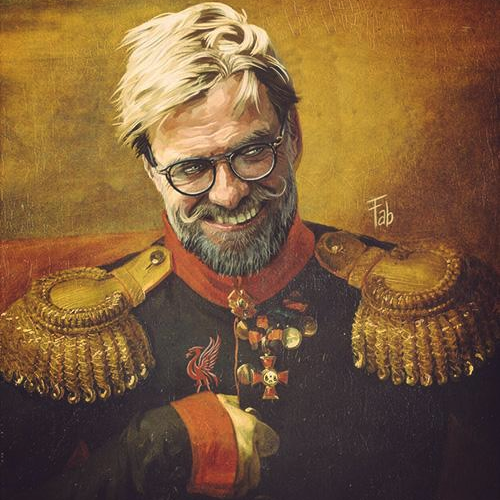
          Liverpool stars painted as historical leaders

          Liverpool manager Jürgen Klopp and record-breaking Reds forward Mohamed Salah feature in a new art exhibition 'Like the Gods' that depicts footballers as historical leaders.

          The instillation is the work of Italian artist Fabrizio Birimbelli (@pupazzaro) and was launched at the Museum of the Russian Academy of Arts in Saint Petersburg to coincide with their hosting of the World Cup finals.

          More than 40 portraits of players and coaches in historical military uniform make up the project, which opened on June 20 and runs through to the end of the tournament.

          Birimbelli's catalogue of work also includes similar depictions of Liverpool skipper Jordan Henderson, Kop hero Steven Gerrard and former Reds such as Dirk Kuyt, Luis Suarez and Fernando Torres.


          What do you mean it could've been anyone? Name me one person who's got a grudge against penguins

          Batman

          F*** off!!!

          Comment


            Originally posted by Yozza View Post
            Birimbelli's catalogue of work also includes similar depictions of Liverpool skipper Jordan Henderson
            Well that's a ****ing disgrace. What's he done that's so special

            Comment


              Latest Athletic article. Reading what other players are saying really highlights how good a period it is to be a Liverpool fan. We've had some absolutely **** and will again in the future. This bit that's currently happening will b something we look back at, long for and tell our kids about for the rest of our lives. We are currently in the "good old days" so let's enjoy it


              When Jurgen Klopp first became Liverpool’s manager, players were shocked by his physical demands in training and injuries were sustained because they were not used to the new level of intensity.

              Under previous managers, the squad was encouraged to rest as much as possible but Klopp expected them to train for longer and at match-pace because he believed this helps teams finish games stronger and therefore avoid more injuries.

              “Players tend to pick up muscle injuries when they’re tired,” says one former first-teamer, who ended up leaving partly because his body could not cope with the strain of the environment Klopp was creating. “You don’t see that happen very often any more at Liverpool. They have to be the fittest team in the league.”

              In Klopp’s first weeks in charge, it was also noticed how sessions relating to team shape were focused on what happens in the wide areas of the pitch rather than the centre.

              Klopp was flipping more than one accepted norm in football on its head. It is commonly thought any manager builds the spine of a team first, working from back to front. Instead, players talked amongst themselves about the reasons why he focused on the forwards first and paid attention to the smaller details on the flanks before focusing on what he really wanted through the middle and at the back.

              Largely, this was explained by his desire to gegenpress, which only works if the forwards understand the concept and work very, very hard indeed. It was Klopp’s belief that an opponent’s full-back is the most vulnerable player on the pitch when pressure is applied because of his closeness to goal and the regularity with which he receives possession from the keeper.

              The consequence was hours upon hours of drills — and some of Liverpool’s players questioning the wisdom of such dogged repetition. In those early days, Klopp could afford to “be a bit boring” in training and drive his team almost to the point of exhaustion because he was new to the job, he knew he had the backing of Liverpool’s owners and his personality brought excitement or “something very different” in other areas of his guidance.

              Another player who has since left the club remembers Klopp illustrating how he wanted the team to set up from goal-kicks, which he saw as an opportunity to impose pressure. The German used a 4-1-4-1 formation for much of that first season but the wide midfielders were instructed to get close to the centre-forward when goalkeeper Simon Mignolet had the ball at his feet, allowing the full-backs to push forward. Liverpool’s overcrowding around the opponent’s centre backs meant, in theory, they would win possession quickly from any clearance and build from there, with those in advanced areas instructed to take positions which created triangles that defenders could not ignore, dragging them into territory they did not like. With so much going on in the centre, Klopp believed this would allow the full-backs room to cause problems.

              Liverpool’s youth team players were regularly invited up to Melwood as Klopp tried to form his own opinions about standards. He was impressed by Nathaniel Clyne’s dynamism as well as his first touch but unconvinced he had the crossing or passing ability to become his long-term right-back. Though he was willing to give Alberto Moreno more chances because of his speed, as well as his determination to prove critics wrong, he was also unsure whether the Spanish left-back possessed the levels of concentration to make that position his own.

              Opportunities were given to youth teamers with high hopes. It became clear to one of them that Klopp had very uncommon expectations relating to skill-sets and positions. “I grew up thinking you had to be fast and aggressive to play at the top level as a full-back. Klopp was looking for something different, though…”

              Klopp would speak often about the full-back being “the spare man” or the “quarterback”. Football’s playmakers are usually in midfield but the shape of Klopp’s team meant more time was offered to the full-back than any midfielder, who was instead expected to cover for the more creative players elsewhere on the pitch. This would lead to major disappointment among the queue of exciting, ball-playing midfielders in Liverpool’s academy hoping for their opportunities at first team level.

              “I was thinking, ‘You’ve got to be more than just a full-back to get into this team,’” one of the youth players recognised. “You can’t just run up and down the wing and take care of your own area. The way Klopp was talking, he saw the full-back as one of his most important players. It made me realise I had to jump up a few levels to have a chance of having a real chance under him.”

              There are those at Melwood who remember Trent Alexander-Arnold’s earliest training sessions, when Klopp was blown away by his positive energy. He had arrived at Liverpool as a centre-forward, then been played on the wing and in central midfield as well as in defence. His appreciation of all positions meant it was anticipated he would eventually become Steven Gerrard’s long-term successor and potentially the driving force of the team from midfield. Yet Klopp saw the future differently and this related to his impression of what a midfielder should be, “not the star but doing a lot of the work very few people watching really appreciate,” as one of the youth players who never made it beyond a few training sessions at Melwood now recognises.

              “Trent was always trying to move the ball forward and that’s what the manager wanted to see,” he recalled. “You wouldn’t say Trent took risks but going backwards was the last option for him. Trent is at his best when he’s allowed to be on the front foot and being right-back makes that possible. In the middle of midfield, you’ve got to play a lot of the time with your back to goal and cover for others but at full-back you can play an even more creative role in this team because of the way it is built. Klopp has totally changed the responsibilities of players and made it work and I don’t think he gets enough credit for that.”

              Alexander-Arnold’s game has improved since then, through experience and rising confidence. The kind of raking cross-field passes he routinely makes tend not to be encouraged in modern football, because coaches believe it gives defenders the time to re-organise. Yet he strikes the ball so cleanly it means Liverpool’s threat can appear to be coming from one place when suddenly it arrives from another. Virgil van Dijk’s passing range from a deeper position and an altogether different angle increases the danger. One moment it might appear a team are safe. The next, their goalkeeper is picking the ball out of the net.

              “The system under Klopp is made for Trent,” says another ex-Liverpool player, who now represents a lower league club where the manager constantly references Klopp’s European champions as the blueprint he wants to try to follow. The player thinks Alexander-Arnold has since emerged as one of the best passers in the world. “The number of times you see him switch play, it reminds me of Steven Gerrard. And he’s (Gerrard) the greatest player I’ve ever trained with.”

              This season and last, Alexander-Arnold and Andrew Robertson have created more goal-scoring chances than any other player in the Premier League bar Eden Hazard.

              Now the Belgian has gone to Real Madrid, Liverpool’s full-backs are statistically the most creative players in top-flight English football.

              What is it like to try and stop Liverpool, or specifically their full-backs?

              Last season, Bournemouth conceded seven goals in two league games against Klopp’s team without scoring themselves.

              “They were terrific with the way they attacked and the way they ran,” Steve Cook, the Bournemouth central defender, reflected.

              Mohamed Salah’s trickery, Roberto Firmino’s strength and skill or Sadio Mane’s directness may catch the watching eye of a spectator but when listening to those who are trying to stop them, it is the side’s collective effort that tends to be discussed first.

              “The way they work, the way every one of their players is willing to graft and run, and they look after the ball so well,” Cook explained following a 3-0 defeat at Anfield in February, where Bournemouth barely got out of their own half. “The way they attack is really difficult to defend against. They don’t really give you much chance to get your game going. It really is tough to play against.”

              The tactical approach and appetite of the team, as well as the level of quality in it, makes Liverpool “almost impossible to stop,” says a Premier League defender with experience of losing against them more recently.

              He has played for the same club for most of his career, under a manager who reliably comes up with a convincing plan that encourages players to think they are capable of beating more illustrious opponents. Against Liverpool under Klopp, however, it has not quite felt the same way “because of the spread of the threat — how do you stop a team which has five players, including the full-backs, that can kill you at any moment? It’s very rare they all have a bad day at the same time…”

              The manager in question targeted Liverpool’s wide areas because the advanced positions taken up by each full-back leaves space for wingers to potentially exploit. Yet getting the ball into those areas is more difficult than you might imagine because Liverpool commit so many players forward and that makes it harder to see the bigger picture when the pressure is on. “You feel like you can’t get out, even with a longer pass because the moment you try to steady yourself Liverpool’s players hunt you down.”

              Under previous managers and at different clubs, the defender looked forward to playing Liverpool because he felt he always had a chance of winning. That isn’t the case now.

              He “hates” playing against Firmino particularly, because of the way he drifts around, “pulling you into places you really don’t want to be — if you go too far, that leaves the space for the other two (Salah or Mane) to get you.” Firmino, he says, “is like two players in one — he makes it feel like Liverpool have an extra man.”

              Liverpool’s overloading in the centre of the pitch means two central defenders are often forced into marking three players. This leads to the full-backs tucking in and more room for Alexander-Arnold and Robertson to, as the defender puts it, “have fun in”.

              He feels jealous of Liverpool’s players and the mood he sees from afar. “They work ****ing hard and they don’t give you an inch,” he says. “But there’s also the room to express yourself. The balance is near-on perfect. When you have that sort of understanding, it’s almost impossible to stop.”

              Whenever the game appears to move along, lots of reporters are told the same message by former footballers, “but this has happened before…”

              “False 9 – don’t give me that, Kenny Dalglish was the first false 9…it’s not a new thing…” Phil Thompson once said in relation to a question that was originally about ball-playing central defenders and the concept of Total Football, which wasn’t — according to Thompson — created by the Dutch but instead by Bill Shankly and his decision to use both himself and Emlyn Hughes at the back despite their histories in midfield.

              A similar response came from Chris Lawler as he sat in his front room in Liverpool when he was reminded of his goals record in a red shirt. “Sixty-one goals,” he said, “in 549 games wasn’t too bad for a full-back.”

              And he was right. Lawler’s nickname was Silent Knight because of his ability to ghost into positions of opportunity without detection, contributing enormously towards Liverpool’s attacking threat in the late 1960s and early 1970s.

              Lawler loved telling stories about Shankly even though he was the quiet man of the team, which he thought to some degree protected his stealth on the pitch. He recalled training sessions at Melwood when seven-a-side games were played without proper goals. Shankly took a shot which everyone else involved thought had gone over the bar. He knew he’d get an honest answer off Lawler, who he turned to for salvation. “I told him that it had gone over and the team was in stitches,” he laughed. That made Shankly tell everyone in the vicinity, “He doesn’t say a word for years and then when he does he tells a lie…”

              Lawler had joined the club just three months before Shankly’s appointment as manager and left 16 months after his departure. Like Ian Callaghan — the club’s record appearance holder — he described himself as “Shankly’s player”.

              This was around the period where England won the World Cup with a team selected by Sir Alf Ramsey that did not include natural wingers. The team’s width instead came from the full-backs. This success, according to Lawler, made Shankly think about the way his own side played.

              “He didn’t mind me joining the attack but only when we won,” Lawler smiled. He could remember losing a game in Switzerland to Servette in 1971 when he nevertheless scored. “It finished 2-1 and their winner came after I went forward and didn’t get back quick enough. After the match, I got a bollocking. Shanks said, ‘You shouldn’t have done that.’”

              Many of Lawler’s goals came from set-pieces. Corners and free-kicks allowed him to use his height as well as his long legs to get on the end of deliveries.

              “But Shanks didn’t like me going forward so much in the European matches away from Anfield,” he recalled. “At home, he’d shout, ‘Get up there…’ because I was taller and a lot of the foreign teams were smaller. They couldn’t deal with the physicality. Away, it was different, because they’d try and get at you more. If you strayed too far up you’d be in trouble.”

              Liverpool’s formation now is 4-3-3. Back then, it was 4-4-2. Shankly came to use Steve Heighway as a left-winger but in front of Lawler was Callaghan who was more of a wide-midfielder, and tucked inside to help the central players. This allowed Lawler the space to move forward and provide the crosses for Liverpool’s forwards to attack. Though he offered “some” assists (there is no such data available from those days), Lawler would find himself more often than not getting on the end of crosses from the other side of the pitch and scoring goals himself rather than creating lots of opportunities for his team-mates.

              “Arriving late on the back stick,” he said, “was a bit of a forte of mine. It was something I got in the habit of doing. I wouldn’t say Shanks told me to do it. It wasn’t really by design. As players, we trained so often together with the same group, we’d just know where certain people would be.”

              Lawler was succeeded by Phil Neal as the team’s right-back. Neal would become the club’s most decorated player as well as the team’s penalty taker. His goal in the 1977 European Cup final came from open play — as did Alan Kennedy’s from the other side of the pitch in the same final four years later. Kennedy was the Liverpool left-back who scored another winning goal in another final in 1984, though his strike against Roma was a penalty kick.

              Such facts are no coincidence. Liverpool’s full-backs of the past were perhaps better than their contemporaries at sensing the opportunity to get forward. Over time, this has evolved into becoming part of the strategy. At the club’s academy, it is recognised that full-backs are not really full-backs at all any more. They are instead wingers with defensive responsibilities. “Since Klopp became manager, it has been recognised as an attacking position,” says one source. “To play for Klopp, you have to be a willing runner in any area of the pitch. But full-backs probably have to be better passers of the ball than midfielders.”

              According to Jason McAteer, attacking responsibilities became more defined at Liverpool for the first time under Roy Evans in the mid-1990s when he switched the team’s formation from 4-4-2 to 3-4-1-2. McAteer became Liverpool’s right wing-back having started his career as a full-back before recycling as a box-to-box central midfielder at Bolton Wanderers, where his lung-capacity complimented the ball-playing skills of Tony Kelly.

              It had been Evans’ plan to use McAteer in the same role alongside Jamie Redknapp but a few games into the 1995-96 season he faced the challenge of accommodating some big-name stars, including John Barnes. The new shape meant Barnes and Redknapp could sit deep in midfield and allow Steve McManaman to roam in the No 10 role where he was so effective, but it also meant McAteer’s energy was used out wide instead.

              McAteer describes the change in system as “revolutionary for Liverpool”, a club which had played the same way for decades, yet that team rarely worked on shape. “The idea remained that if Liverpool signed you, you simply knew what to do.” McAteer was told to think more about how he could hurt the opponent rather than how he could help the defence behind him, though Evans was insistent that both wing-backs should never go forward at the same time.

              McAteer saw McManaman’s role as crucial to the whole team, “if he didn’t play well, we tended not to,” but particularly for his own possibilities to impact on the game. “Macca would drag defenders into places they didn’t want to be. They are different players but Firmino does that for Liverpool now, which allows the full-backs the space they need to really do some damage. If another team stopped Liverpool, it was because they’d stopped Macca. When Firmino’s not there, this Liverpool team doesn’t seem quite as fluid.”

              Though McAteer was naturally the most attacking of Liverpool’s wing-back options, Stig Inge Bjornebye delivered more assists than any other player in the Premier League during the 1996-97 campaign. The Norwegian was a less dynamic player than McAteer but his crossing ability was underestimated. “Because Macca tended to drift to the right of the pitch, teams tried to stop what we were doing on my side rather than think about the threat coming from the left,” says McAteer. “It shows you what can happen if you obsess too much about one player. It reminds that if you try and stop Firmino, it leaves the space for Salah, Mane, Trent or Robertson to do their stuff.”

              On the corner of Sybil Street and Anfield Road is a mural of a footballer whose face you cannot see. The identity of the player is revealed instead not only by the name and the number on the back of his red shirt but also his posture. His solid-looking shoulders and his sense of balance help him influence the game from his position at right-back to a standard unrivalled by other 21-year-olds.

              It is different at Liverpool now compared to McAteer’s time, a club where full-backs are considered heroes and both of them are even allowed to attack at the same moment. Against RB Salzburg in the Champions League, the potential consequence of this was illustrated to devastating effect after right-back served left-back, who appeared in the centre-forward position, and a goal arrived from six yards out.

              There are people who speak on Klopp’s behalf willing to admit even he was not beyond Barcelona’s influence; that the challenges faced by Pep Guardiola made him consider his own approach several years ago. “Jurgen loves problem solving,” says one of his advisors. “Both Barcelona and Borussia Dortmund were having a rough time and this made him look around for solutions.”

              Then, he was losing his most creative midfield options. Nuri Sahin went to Real Madrid, Shinji Kagawa signed for Manchester United and Mario Gotze eventually joined Bayern Munich. ‘There had to be another way of creating more chances from other areas of the pitch,’ Klopp supposedly thought.

              From afar, he followed developments at the Nou Camp and was able to recognise tactical shifts there. This was around the time Guardiola’s team started to lose to better European opponents than those regularly presented by La Liga. He’d replaced Eric Abidal with Jordi Alba at left-back but had underestimated Abidal’s importance as a player who was comfortable on the ball but also acutely appreciated his defensive responsibilities. Previously, his presence allowed Dani Alves to attack without much consideration for what was happening behind him, and rarely would Barcelona get punished because Abidal was always there and this allowed the two team-mates inside of him to shuffle over and offer the cover needed to guard against counter-attacks.

              Alba’s arrival changed the dynamic. Guardiola was already concerned about Barcelona’s predictability by the time Abidal was struck down by liver cancer but his attempt to innovate came at some cost with opponents exploiting the space left by Alba. This prompted a rethink and from that point onwards, both full-backs would be allowed to stream forward — but only in a 3-4-3 formation. Rarely under Guardiola did this happen whenever he named four at the back.

              It is any manager’s job to judge the tactical set-up of another and Klopp determined that Barcelona’s problems then were not all Alba’s and another way of looking at it was, that Barcelona’s midfield was packed with creativity but not necessarily legs.

              Alba signed in 2012 and the first two seasons of his Barcelona career were spent under Guardiola. Alves remained there until 2016. Yet the last time Alves and Alba were photographed together celebrating a goal was in 2013, when Barcelona recovered from two goals down to beat AC Milan 4-0 in the second leg of a Champions League quarter-final. Alba had scored the fourth that night after being served from the right of the pitch but not by Alves and instead by Alexis Sanchez. Alves was further back, helping protect his team’s slender lead.

              The pair were once viewed as the most attacking full-backs in world football but, one never set the other up for a goal. While Alves scored 16 times between 2012 and 2016, assisting with 30, Alba registered eight goals and contributed 22 assists across four seasons. While it has taken Alexander-Arnold two and a bit seasons to make 20 assists and score five goals, Robertson has been a Liverpool regular for less than two years but already has 18 assists and three goals.

              Should the Liverpool pair continue at the same rate, the records of Alves and Alba will be passed halfway through 2020-21. Maybe then, the names of football’s greatest modern full-backs will be different.

              (Top photo: Paul Ellis/AFP/Getty)
              Originally posted by fah-q
              Didn't someone once see Philip Schofield ****ting into a crisp packet?

              Comment


                Ideal for those at Man Utd to read and ask themselves whether they see Solskjaer doing this sort of work on the training ground.

                This applies across the board to those at top clubs, including us, when Klopp leaves.

                Comment


                  Three articles munged into one.
                  Oh I don't know.

                  Comment


                    I see what people are referring to now when they talk about Athletic. Great article but halfway through starts to feel rambling.

                    Does make a mockery though of those saying TAA should be moved to a winger.

                    Comment


                      Originally posted by EwarWoo View Post
                      I see what people are referring to now when they talk about Athletic. Great article but halfway through starts to feel rambling.

                      Does make a mockery though of those saying TAA should be moved to a winger.
                      There are some good pieces, and the writing is really good, but its, they feel, they have to put a thousand words, when 300 would do - Overkill.

                      They'll get there, there are some really really good articles across the site, but for the UK, I reckon they will find their feet after Xmas and come back with something that's really readable.
                      I make no apologies, this is me

                      Comment


                        Lovren points to Klopp’s four words that turned everything around at

                        Liverpool manager Jurgen Klopp famously pledged to turn “from doubters to believers” when he arrived at Anfield and while that was directed at long-suffering fans it was a message embraced by his players.

                        When the German made the pronouncement at his first press conference it was viewed as a PR masterstroke.

                        He could not have thought, at the time, it would resonate with his squad but it did and it has stuck with those who remain after all the changes in the intervening period since 2015.

                        “Four years already? I’m getting old. Yes, we started to believe when he said, ‘from doubters to believers’,” was defender Dejan Lovren’s assessment.

                        “He changed things in the club, from small details like saying, ‘good morning’ to everyone to cleaning your table.

                        “We are, I think, raised at my age that when you see an older person you will say, ‘good morning’. It is about respect.

                        “When you have this outside of the pitch you will feel it also on the pitch. It is the simple things.

                        “It is about things like the food; he brought in people who are the best in these positions, and he knows what he is doing.

                        “I think some part of these details are missing in some clubs.”

                        Klopp’s first opponents when he took over in October 2015 were Tottenham at White Hart Lane.

                        Fast-forward to present day and Spurs are next up, albeit at Anfield.

                        They last met in June’s Champions League final, where Liverpool won their sixth European Cup, but the two sides’ respective fortunes have taken different paths since then.

                        While Liverpool are unbeaten in the Premier League, eight wins and a draw giving them a six-point advantage over defending champions Manchester City at the top of the table.

                        Tottenham, by contrast, trail by 13 points having registered just three league wins so far.

                        Lovren said it shows getting to the top and staying at the top are two different things and that can be seen in how the two squads have developed since that meeting four years ago.

                        Of the Liverpool squad which was named for that goalless draw only Nathaniel Clyne (currently injured, otherwise he would already have been transferred out), James Milner, Adam Lallana and Divock Origi remain at the club.

                        By contrast Spurs still have Huge Lloris, Danny Rose, Tony Alderweireld, Jan Vertonghen, Erik Lamela, Dele Alli, Christian Eriksen, Michel Vorm, Ben Davies and Harry Winks.

                        Essentially, little has altered personnel-wise at the club.

                        “It can change quickly. Three or four years ago we didn’t have the best start,” Lovren added.

                        “With the improvement, the belief, with the work of the team you can achieve anything. This is what Klopp told us.

                        "We have brought in Virgil and you can see how good a player he has become learning from me.

                        “The most difficult part is when you are on top to stay on the top. When you sometimes drop it is about showing your inner strength, it is about the character of the team to jump back.

                        “I think we learned about all our mistakes from previous years. I think we are on the right path.

                        “He (Klopp) said to us it is exceptional that we lost the final against Real Madrid and we came this year and won it, it says a lot about the team.”

                        Last edited by red g; 25-10-19, 02:47 PM.
                        _____________________________________

                        Weak willed, Wank or do they have a masterplan?

                        Think we have the answer..Slot!!

                        Comment


                          top shaggying

                          Comment


                            Originally posted by red g View Post
                            "We have brought in Vincent and you can see how good a player he has become learning from me.
                            [/url]
                            Did you mean to edit with Virgil not Vincent, unless we signed Kompany on sly?

                            Comment


                              Originally posted by DeeTheDog View Post
                              Did you mean to edit with Virgil not Vincent, unless we signed Kompany on sly?
                              _____________________________________

                              Weak willed, Wank or do they have a masterplan?

                              Think we have the answer..Slot!!

                              Comment


                                Vincent van Dijk
                                Hello mert.

                                Comment

                                Working...
                                X