Some years ago I read something by a reasonably well respected cultural commentator (I forget who) that posited the idea that beards become popular during periods when men feel their masculinity is under threat or otherwise needs displaying.
Probably a load of balls (hoho) but maybe there's something to it.
. Suppose you have a physicist and a sociologist standing at the side of a field, observing a set of events unfolding on the field. The physicist does [describes] it using the terminology of mass and velocity and frequency of radiation and the rest. And the sociologist does it by describing it as a rugby match.
Some years ago I read something by a reasonably well respected cultural commentator (I forget who) that posited the idea that beards become popular during periods when men feel their masculinity is under threat or otherwise needs displaying.
Probably a load of balls (hoho) but maybe there's something to it.
Hmm.
I have been sporting a beardish growth for the past 6 weeks or so. I have taken to using clippers to trim rather than razors.
I make no judgment about the truth of that particular claim but it raises the broader issue, do fashions really come out of nowhere or do they fit with a prevailing mood, a specific need or desire at any particular time?
Fashion is a social contagion and it's hard to know whether there is any meaning behind it, whether it produces its own meaning or if it's all simply random.
. Suppose you have a physicist and a sociologist standing at the side of a field, observing a set of events unfolding on the field. The physicist does [describes] it using the terminology of mass and velocity and frequency of radiation and the rest. And the sociologist does it by describing it as a rugby match.
. Suppose you have a physicist and a sociologist standing at the side of a field, observing a set of events unfolding on the field. The physicist does [describes] it using the terminology of mass and velocity and frequency of radiation and the rest. And the sociologist does it by describing it as a rugby match.
Some years ago I read something by a reasonably well respected cultural commentator (I forget who) that posited the idea that beards become popular during periods when men feel their masculinity is under threat or otherwise needs displaying.
Probably a load of balls (hoho) but maybe there's something to it.
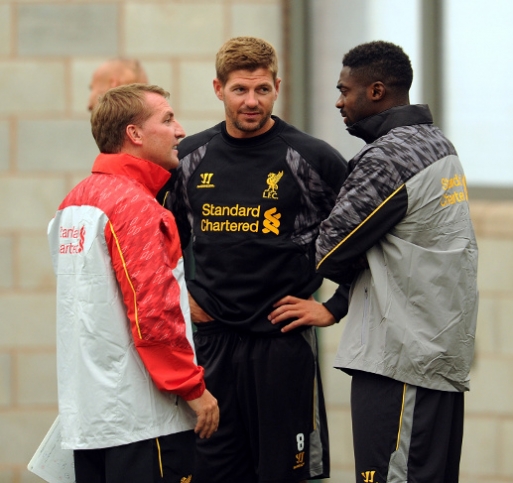
So that's just men in general instead a particular man like Gerrard being insecure towards Kolo? Interesting, but I think he's reading too much into that really, I have bit of a beard but that's just cause I'm too lazy to shave frequently.
* The above is posted in my opinion. Feel free to disagree.
I make no judgment about the truth of that particular claim but it raises the broader issue, do fashions really come out of nowhere or do they fit with a prevailing mood, a specific need or desire at any particular time?
Fashion is a social contagion and it's hard to know whether there is any meaning behind it, whether it produces its own meaning or if it's all simply random.
Good question. I'm not sure. In my case it's because I've finally developed enough to start getting away with it, rather than ending up with a patchy mess. I was recently in a bar in Paris and out of approximately 20 men in there, only one was sans barbe. I am proud to say that it wasn't me.
So that's just men in general instead a particular man like Gerrard being insecure towards Kolo? Interesting, but I think he's reading too much into that really, I have bit of a beard but that's just cause I'm too lazy to shave frequently.
The patterns that emerge from the sum of each individual's decisions might be meaningless. And clearly it's fallacious to impute a socially constructed norm to any individual's decision. But there are relationships between the two levels and I don't think we can just dismiss the very idea that the fluctuating popularity of facial hair is entirely random.
. Suppose you have a physicist and a sociologist standing at the side of a field, observing a set of events unfolding on the field. The physicist does [describes] it using the terminology of mass and velocity and frequency of radiation and the rest. And the sociologist does it by describing it as a rugby match.
The patterns that emerge from the sum of each individual's decisions might be meaningless. And clearly it's fallacious to impute a socially constructed norm to any individual's decision. But there are relationships between the two levels and I don't think we can just dismiss the very idea that the fluctuating popularity of facial hair is entirely random.
So if 5 lazy blokes don't shave they could start a fashion trend. Specially if one of them was Pirlo or Alonso.
* The above is posted in my opinion. Feel free to disagree.


 Waits for some ****er to ask if I'm a lady...




Comment