Announcement

Collapse
No announcement yet.

Brendan Rodgers

Collapse
X
 
  • Filter
  • Time
  • Show
Clear All
new posts

    Originally posted by Buzzo View Post
    Genius - These could be the mutterings of a lunatic on an acid comedown.
    Yes, although you could say that about most of James P's posts.

    .
    Suppose you have a physicist and a sociologist standing at the side of a field, observing a set of events unfolding on the field. The physicist does [describes] it using the terminology of mass and velocity and frequency of radiation and the rest. And the sociologist does it by describing it as a rugby match.


    May the Lord bless this post.

    Comment


      and if at the time of the big explanation, if anyone sat around the telly said oh yeh, i was gonna say that, you know they were talking bollocks
      removing all the weak links makes us stronger

      too many gutless players, no beef or desire. pussies everywhere... sack them all.

      Comment


        slow news day
        Anybody who criticizes Klopp ever is a James Blunt. Nov 2015
        #****CITY

        Comment


          The oldies have taken over the thread

          Comment


            Originally posted by James P View Post


            Another genuine one from the show:

            “The Arches Might Provide A Clue, Not Strolling But He’s Going Too”, accompanied by some sheet music.
            Ted’s Explanation: “Well the first three letters of arches might have been clue enough, but we also said not strolling but he’s going too. Well if you take away HES from arches, all you have left is ARC. If you rearrange that with the sheet music, you’re left with ‘Music Maestro Please’. So what do think that means? Maestro! The British Leyland Maestro! You’ve won the car!”
            ...haha! Utter tosh.
            Whoever set the questions/riddles on '3-2-1' must have been on medication...

            Comment


              Originally posted by Neil Young View Post
              Yes, although you could say that about most of James P's posts.

              Comment


                Staying totally off topic.

                Rogers: "This is a composer. German by birth, English by adoption. Best known for an oratorio published in 1741. It was called Messiah. You're bound to know his handle."
                Female contestant: (presses buzzer) "Oh God, I used to have it at school... Handel's Water Music..."
                Rogers: "So who's the composer?"
                Female contestant: "Chopin?"
                (audience shrieks in disbelief)
                Rogers: (shrugs shoulders and turns to other team) "So I can offer it to you."
                Male contestant: "Beethoven?"

                Modifying post.

                Comment


                  Liverpool FC: Brendan Rodgers Tactics – How The Pressing Game Works

                  Welcome to Liverpool Football Club Mr. Brendan Rodgers. To say the Northern Irishman has had a meteoric rise through the managerial football ranks is akin to stating: “Messi, that boy’s decent”. An understatement of epic proportions. But somehow, through hard work, perseverance, and total belief in a footballing philosophy, Rodgers has managed to nab himself one of the most revered jobs in world football. First off, let us look at the timeline of how Rodgers ended up at Liverpool FC.

                  How Brendan Rodgers Arrived At Liverpool FC

                  1991 – Studies coaching badges at Reading and works his way up through youth system, eventually being appointed youth team manager

                  2004 – Scouted by Jose Mourinho and appointed Chelsea youth team manager

                  2006 – Gets in-house promotion to reserve team at Chelsea

                  2008 – Leaves Chelsea to become Watford manager. Watford end up finishing 13th in the Championship

                  2009 – Resigns from Watford position and becomes Reading manager. Sacked after 6 months in the job due to very poor results

                  2010 – Becomes new Swansea manager and gets them promoted to the Premier League through the play-offs

                  11/12 – Takes Swansea to an 11th place finish in the Premier League, amassing 47 points in the process

                  2012 – Appointed Liverpool Coach

                  Origins of Pressing


                  But what of that footballing philosophy we so often hear of? My colleague has all ready posted a fantastic piece here on how Brendan Rodgers implements his brand of tika-taka and how the current Liverpool FC squad is likely to fit into that style of football. And to be honest there is not much more I can add to that part of it. However, what of this pressing game we hear of?

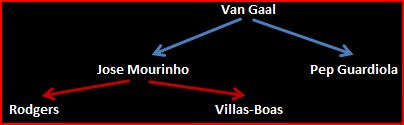
                  Firstly it’s a tactic/philosophy that is linked through successive coaches. From Van Gaal, through his understudy’s Jose Mourinho and Pep Guardiola, and again passed down to two more disciples under Mourinho, Brendan Rodgers and Andres Villas-Boas. It is no coincidence that these coaches are all linked in some way or another. And it is an insight into how this type pressing game has evolved.

                  Some of the (lazy) comments I currently read on social media and in newspapers in relation to Swansea’s passing game are: ‘they pass for passing sake”, “they only pass backwards, and sideways” etc. Like there is no plan behind it. But that is doing Rodgers style of football a great injustice and is demeaning to the man’s footballing intelligence.

                  Mostly, in Rodgers case, the reasons for passing backwards and sideways are purely tactical. Sometimes you need to recycle the ball for long periods in order to recover. Other times, it’s to create angles for passes, and to dominate the opposition.

                  Originally posted by Brendan Rodgers
                  “When going forward, the best way to move the ball up the field is to create angles of diagonal pass. If you have two banks of four across defence and midfield there are no diagonal passes on. The system needs to be more fluid.”
                  It is also used as a form of defence. Of course, if you have possession of the ball, then, simplistically the opposition cannot score. Furthermore, the belief is, if you have possession of the football, then the opposition are expending more energy trying to hunt you down and retrieve it. Death by a thousand passes if you will. But how does it work? How does one know when to press or not?

                  What Rodgers says about pressure:

                  Originally posted by Brendan Rodgers
                  “The only time we rest is when we have the ball. When we haven’t got the ball is the moment for intense pressure to get the ball back. But you can’t go for 90 minutes, so in order to recuperate and conserve energy, we’ll do that sometimes by building our way through the game.”
                  What is interesting about that quote is: ‘when we haven’t got the ball is the moment for intense pressure to get the ball back’.

                  The Six Second Rule

                  This is based on the principle that when a player regains or receives possession he as at that moment, or for a few seconds, is vulnerable to being dispossessed.

                  But, and this is crucial, if you cannot win the ball back within those 5 or 6 seconds then you must recognize as a team that you can’t run around pressing the ball for 90 minutes. It’s just not physically possible. So you retreat, regain your defensive shape, and wait for the ‘signs’ to start pressing again.

                  Originally posted by Brendan Rodgers
                  “You cannot go (press) on your own,” he says. “You work on zonal pressure, so that when it is in your zone, you have the capacity to press. That ability to press immediately, within five or six seconds to get the ball, is important. But you also have to understand when you can’t and what the triggers are then to go for it again because you can’t run about like a madman.”
                  The ‘Triggers’ For Pressing

                  Why can a player be vulnerable to losing possession immediately after he receives the ball? Well his overview of the entire pitch becomes limited due to him having to make a tackle, interception or other to win the ball back. If he receives the ball from a stray pass then he may also need to look down at the ball to control it, and again lose his overview of the pitch. This is one of the precise moments when you should apply your pressing game.

                  A further trigger to start pressing; if the opposition player with the ball needs to turn back towards his own goal. His options become very limited, he can’t pass forward to a teammate, and his vision of the field ahead of him becomes obscured, so it’s at that moment you apply intense zonal pressure on the vulnerable player.

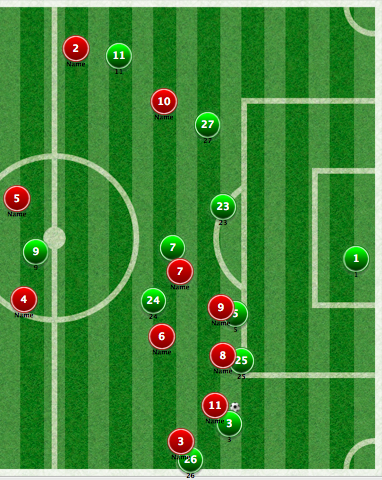
                  If you take a look at the graphic below you can see how limited the number 3′s (green) options are with pressure applied. There are very few passes on except maybe back to his goalkeeper. So the player is left with either pass it back to his goalkeeper or hoof it up the pitch where there is a high possibility in giving it straight back to the opposition.


                  Number 3 (green) turns towards his own goal and immediately the red team apply zonal pressure.

                  As an aside, consider why the great passing players are in fact great; (Alonso, Xavi, Pirlo), if you watch them closely, control of the ball is secondary. They barely look down to see where the ball is, enabling them to have a constant view of what’s going on around them. Vision of your team-mates positions around you is a critical attribute to have in your locker in the modern game.

                  Team Shape

                  Not only is the player who receives the ball vulnerable, but also the entire team. It is the transition phase of the ball: the opposition’s defensive shape has not been set. Thus they are, for maybe 5 or 6 seconds susceptible to intense zonal pressure from the opposition


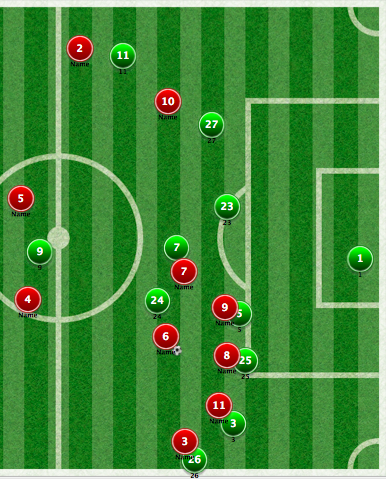
                  High Pressing - Numbers 8, 9, 11 & 3 with zonal pressure and the opposition (green) give the ball away to red number 6

                  There is also another factor to consider.This high pressing allows you to win the ball back closer to the opposition goal.

                  You can see from the graphic used above, how high the attacking team (red) are up the pitch after winning possession. The forward thinking options for red number six, with the ball, are: slip to number 7 who may have an option to shoot, or number 9 can pull of the back of his marker (number 5) and have a route to goal. These are the decisions that you must take immediately after regaining possession. You win it back, and you decide on whether there is a route to goal, if not, you pass it back, recycle possession, and start all over again.

                  Of course, knowing when to press, in zones, and as an entire team is not something that is normally second nature. It must be taught on training ground. It takes footballing intelligence and tactical discipline. Your team and your players need to be in the right positions the moment is upon you to press. One player pressing the ball is futile, it expends needless energy and almost never works.

                  And this may be an area where Liverpool struggle in the early part of the season. Knowing when to press and when not to press. It will be fascinating to watch. However, if Brendan Rodgers can get the Liverpool players to understand this important tactical discipline, then the fruits of that knowledge will start to grow and we may start seeing a very exciting new era at Anfield.

                  Linkage: EPL Index

                  Comment


                    Brendan Rodgers: Resting With The Ball | Top European League Analysis

                    Brendan Rodgers’ appointment as Liverpool manager has prompted some fascinating discussions about his overall playing philosophy and how it might be transferred to his new club. Swansea’s impressive passing statistics have been much quoted in this context; only Manchester City attempted and completed more than them last season.

                    An intriguing aspect of this preference for possession is that it is used as both an offensive and defensive tool. Michael Cox of Zonal Marking previously elaborated on the link between possession and shots attempted per game and showed that in general, teams with more possession had more shots, although there was a large degree of variation around the general trend. However, this only investigates the offensive aspect. The theory behind the defensive aspect is best outlined by the new Liverpool manager:

                    Originally posted by Brendan Rodgers
                    “Then there’s our defensive organisation…so if it is not going well we have a default mechanism which makes us hard to beat and we can pass our way into the game again. Rest with the ball. Then we’ll build again.”
                    The inference here is that by having the ball, the opposition can’t score while you simultaneously have increased your own chances of scoring as you need the ball in order to score. So the question is: is this true?

                    One method of ascertaining how well teams accomplish the twin goals of attempting shots on goal and preventing shots on their own goal is to take the ratio between them. If this ratio is greater than 1, then a team attempts more shots than it concedes. Conversely, if the ratio is less than 1, then a team concedes more shots than it attempts. This is by no means a perfect metric, as not all shots are created equal but it does give us something to begin with.

                    In order to assess whether this has any relationship with passing, I’ve plotted this ratio against the number of short passes attempted per game by each team in the top leagues in England, Spain, Italy, Germany and France in the figure below. The teams from each league are coloured differently and various teams are highlighted for comparison purposes/interest.


                    Relationship between shots attempted:conceded vs short passes per game from all teams in the top division in England, Spain, Italy, Germany and France. The vertical dashed grey line indicates the average number of short passes per game by these teams, while the horizontal dashed grey line indicates the average shots attempted:conceded ratio. All data is taken from WhoScored.com for the 2011/12 season.


                    Broadly, teams that attempt more short passes per game tend to attempt more shots than they concede (correlation coefficient of 0.8 if you are that way inclined). Unsurprisingly, the teams at the extreme ends of the number of short passes are Stoke (229 per game) and Barcelona (655 per game). Barcelona are also at the extreme end of the shots attempted:conceded ratio, achieving well above 2 times as many attempted shots compared to those they concede. This is largely driven by their ability to prevent their opponents taking shots, as Barcelona have the lowest number of shots conceded per game (only 7.3 per game). Barcelona’s shots attempted comes in 10th (16.5 per game). Barcelona are adept at “resting with the ball” but you probably already knew that. Many of the teams analysed attempt a below average number of short passes and concede more shots than they attempt. Ajaccio, FC Cologne and Santander posted the lowest shots attempted:conceded ratio, with the latter two being relegated.

                    Swansea & Liverpool

                    Swansea are one of the few teams that combined a large number of short passes per game with a well below average shots attempted:conceded ratio. The closest side to Swansea in this sense is Athletic Bilbao, another side who value possession and pressing highly. Clearly Swansea keep the ball well and translated this to a reasonable number of attempted shots per game (12.4, joint 15th highest in the EPL, mid-table across all 5 leagues). Furthermore, Swansea’s patient style of play seeks to create higher quality shooting opportunities; a lower number isn’t necessarily a bad thing as it isn’t artificially inflated by long-range pot-shots that threaten the corner flag rather than the goal.

                    However, compared to other teams that play an above average number of short passes per game, their shots conceded per game is relatively high (15.7, 7th highest in the EPL). Indeed, of the 11 teams that conceded more shots per game across the five leagues, 8 of them finished in the bottom 4 of their respective leagues (6 were relegated). As mentioned previously, not all shots are created equal but Swansea conceded 59% of these shots within their own penalty area, which was joint 4th highest in the EPL. Without delving further into numbers and analysis, this potentially suggests that Swansea are good at keeping the ball but perhaps were not as good at transitioning to their defensive duties either individually or collectively when they lost it.

                    Liverpool on average attempted close to 60% more shots than they conceded, with only 8 teams achieving a larger ratio. In Liverpool’s case, this was driven by both being able to execute a large number of shots on their opponent’s goal and combining this with a low number of shots on their own goal. Liverpool ranked 4th for shots attempted in the EPL (6th across all 5 leagues) and 3rd for shots conceded (15th across all 5 leagues). This was combined with the 7th highest number of short passes per game in the EPL. As has been shown many times over the past season, Liverpool’s major problem statistically was their woeful translation of shots to goals.

                    The way forward for Liverpool

                    Liverpool under Kenny Dalglish were hardly a team that could be described as a “route one” football team, although the passing style was at times impatient and overly focussed upon crossing to what often seemed like unidentified targets in the penalty area. However, there is a significant difference between the number of short passes played by Swansea (497 per game) compared to Liverpool (440 per game). Next season, Liverpool will presumably move towards and perhaps exceed 500 short passes per game as the influence of Rodgers’ possession orientated playing philosophy takes hold. At the very least, Liverpool should be looking to maintain their shots attempted:conceded ratio from last season to the next. A more patient style of play may help to deliver more players in the final third in order to create and take shooting opportunities. If such patience also delivers some more-composed finishing, then Liverpool under Brendan Rodgers could be very exciting indeed.

                    Linkage: EPL Index

                    Comment


                      That's some inspirational reading. On a personal note, a younger me would have been fantastic under him. I play much like Alonso but with more pace. Just never had an engine so couldn't track people and would tire too quickly. Under his system most of that running would be redundant.

                      After some fine tuning Gerrard could turn into a world class player again for many years to come, much like Giggs did for manure for so many maturer years.
                      One tit for another.

                      Comment


                        Deleted.

                        Comment


                          Originally posted by BigChief View Post
                          That's some inspirational reading. On a personal note, a younger me would have been fantastic under him. I play much like Alonso but with more pace. Just never had an engine so couldn't track people and would tire too quickly. Under his system most of that running would be redundant.

                          After some fine tuning Gerrard could turn into a world class player again for many years to come, much like Giggs did for manure for so many maturer years.
                          I played like Steve Heighway, just didn't have the tache...

                          Comment


                            Those articles are interesting. Still unconvinced that our current players are suitable to the system. Hopefully I'm proved wrong.

                            The more I read the more that the only player whose off the ball game suits the system appears to be Lucas. There are a few more who might well learn but I think the difficulties Mascherano had adapting to this type of play at Barcelona will prove instructive.

                            I really think the first half of next season at least will be a struggle for us.
                            "The man who never alters his opinion is like standing water, and breeds reptiles of the mind."
                            -- William Blake

                            Comment


                              Originally posted by dww View Post
                              Those articles are interesting. Still unconvinced that our current players are suitable to the system. Hopefully I'm proved wrong.

                              The more I read the more that the only player whose off the ball game suits the system appears to be Lucas. There are a few more who might well learn but I think the difficulties Mascherano had adapting to this type of play at Barcelona will prove instructive.

                              I really think the first half of next season at least will be a struggle for us.
                              I'm undecided. I think we have seven players that would look comfortable in a side set up by Rodgers - the back five, especially the full-backs, Lucas and Suarez. Although, I'm still trying to get my head around what Rodgers would ask of Suarez and even more so of Carroll.

                              Henderson and to a lesser extent, Shelvey, look like they could play a big part of our future. Gerrard needs to take on board what Rodgers will ask of him when played in the centre and it will be interesting to see if Rodgers moves him up and right.

                              But I agree, next season is a right off; we'll be hit and miss and it will be difficult to get any momentum. An improvement in results at Anfield and a position higher than eighth, as well as some games where we can see a style being formulated, will be a good season in my opinion.

                              Comment


                                Originally posted by Muddled View Post
                                I'm undecided. I think we have seven players that would look comfortable in a side set up by Rodgers - the back five, especially the full-backs, Lucas and Suarez. Although, I'm still trying to get my head around what Rodgers would ask of Suarez and even more so of Carroll.

                                Henderson and to a lesser extent, Shelvey, look like they could play a big part of our future. Gerrard needs to take on board what Rodgers will ask of him when played in the centre and it will be interesting to see if Rodgers moves him up and right.

                                But I agree, next season is a right off; we'll be hit and miss and it will be difficult to get any momentum. An improvement in results at Anfield and a position higher than eighth, as well as some games where we can see a style being formulated, will be a good season in my opinion.
                                I think lots of the players could work on the ball. It's off the ball and in transition I think we are lacking. I think eventually Shelvey and Henderson will thrive in the new system but they will need to work to get hard.

                                I can't decide how hard the defenders will find the transition - without Lucas last season they struggled as a unit I thought. I think they will be asked to be more proactive and that would seem to have been one of the failing last year. That said I think the way the midfield sets up can have a big impact on the defense and so behind a newly organised unit they might do well. Again you might expect that in the end all four of our first choice defenders might well see benefits from the evolution seemingly signaled by Rodgers arrival.
                                "The man who never alters his opinion is like standing water, and breeds reptiles of the mind."
                                -- William Blake

                                Comment

                                Working...
                                X